Table of Contents
- The Legend of the Nephilim: More Than Just Myth?
- The Scientific Shock: Unexplained ‘Ghost Lineages’ in Human DNA
- Is Our ‘Junk DNA’ Hiding Ancient Secrets?
- Giant Skeletons, Ancient Ruins, and the Search for Physical Evidence
- Separating Mainstream Genetics from Radical Theories
- Can You Test Your Own Genome for Mysterious Ancestry?
- Frequently Asked Questions
I still remember the night I stayed up until 3:00 AM digging through scientific journals and genetic database forums. It all started when I got my own ancestry kit results back. Like millions of other people, I wanted to know where my ancestors came from. But as I looked closer at the tiny percentages of ‘unassigned’ and ‘archaic’ genes, a weird question popped into my head: Is there more to our family tree than mainstream history books let on? Could there be truth to the legends of ancient giants, and is it possible that Nephilim DNA is still floating around in our modern genetic code?
If you have ever spent time reading ancient texts, you know the stories. Across almost every ancient culture, there are tales of massive, powerful beings who walked the Earth. In the Bible, they are called the Nephilim—hybrid offspring of heavenly messengers and early human women. For centuries, these stories were treated as pure mythology. But over the last decade, geneticists mapping the human genome have run into some massive, unexplained anomalies. They have found ‘ghost lineages’—DNA from unknown ancient species that we have never found fossils for. Today, we are going to dive deep into these genetic mysteries to see if science might be accidentally proving the existence of Nephilim DNA.

The Legend of the Nephilim: More Than Just Myth?
To understand why researchers are looking at our genetic code for answers, we first have to understand who the Nephilim actually were. The word ‘Nephilim’ comes from the Hebrew root meaning ‘to fall’ or ‘the fallen ones’. According to ancient texts like Genesis and the Book of Enoch, these beings were giant, super-strong, and highly intelligent. They were the crossbreed of the ‘sons of God’ and human women. Because of this unique mix, the legend says they possessed physical and mental traits that far exceeded normal human limits.
For a long time, historians assumed these tales were just symbolic. But what if they were literal? If these massive beings actually existed and had children with early humans, their genetic material wouldn’t just vanish into thin air. It would be passed down through generations. Over thousands of years, those unique genetic markers would get diluted, but they would still leave a trace. This is why the search for Nephilim DNA has become such a fascinating rabbit hole. If they were real, we should be able to find their genetic footprint right inside our cells.
Of course, the major roadblock has always been finding a baseline. To prove someone has Nephilim DNA, we would first need a confirmed sample of Nephilim DNA to compare it to. Without a fossilized giant skeleton to extract clean genetic material from, scientists are left looking at the next best thing: unexplained, highly unusual sequences in modern human genomes that do not match Neanderthals, Denisovans, or any other known hominids.

The Scientific Shock: Unexplained ‘Ghost Lineages’ in Human DNA
Here is where the hard science gets incredibly interesting. When geneticists mapped the human genome, they expected to find a clean, predictable line of descent. Instead, they found a complicated, tangled bush of ancestry. We already know that modern humans carrying non-African ancestry have about 1% to 2% Neanderthal DNA. People of Melanesian and Indigenous Australian descent carry up to 4% to 6% Denisovan DNA. But recently, scientists discovered something else: a ‘ghost lineage’ in populations from West Africa and other regions.
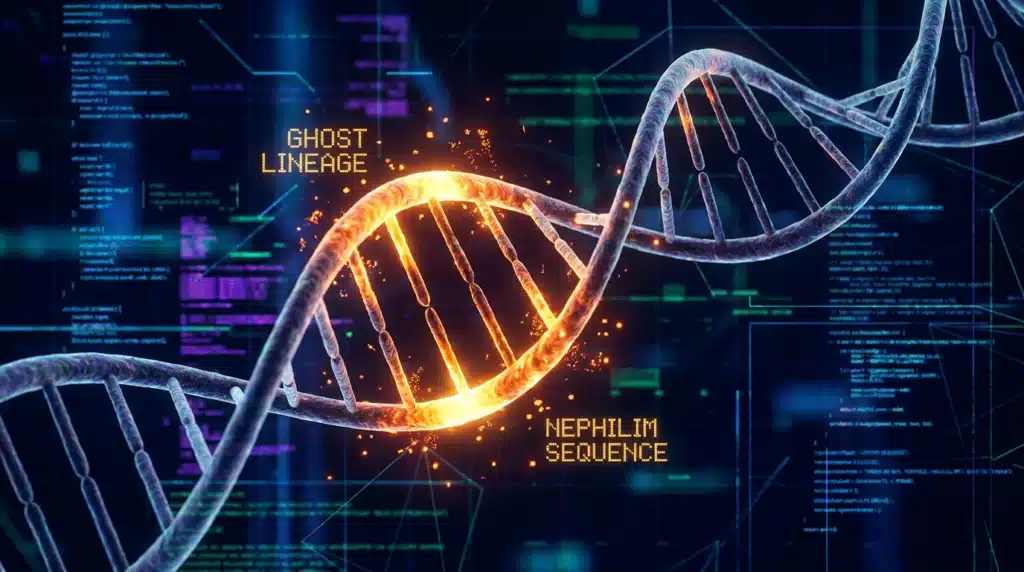
A ghost lineage is a term scientists use when they find a set of genetic markers in modern humans that clearly came from a distinct, separate hominid species—but we have absolutely no fossil record of that species. It is a ghost in our code. In some West African populations, up to 19% of their genetic makeup comes from this mysterious, unknown ancestor. This has led independent researchers and ancient history enthusiasts to ask a thrilling question: could this ghost lineage actually be Nephilim DNA?
This unknown ancestor lived, thrived, and interbred with ancient humans, leaving behind highly resilient genetic material. What makes this so mysterious is how distinct these genetic blocks are from modern human sequences. They are incredibly ancient and highly complex. When we look at these unexplained anomalies, it is hard not to wonder if we are looking at the genetic remnants of a forgotten, legendary species. The scientific community calls it an archaic ghost population, but to those interested in ancient mysteries, it looks a lot like Nephilim DNA hiding in plain sight.
Is Our ‘Junk DNA’ Hiding Ancient Secrets?
For decades, biology teachers taught us that a massive portion of our genetic code—about 98%—was just ‘junk DNA’. We were told these non-coding regions were useless, evolutionary leftovers that had no function. But as genetic technology improved, we realized how wrong that was. This so-called junk DNA actually acts as a massive control panel, turning genes on and off, regulating complex traits, and holding the historical record of our species’ survival.
If Nephilim DNA is indeed present in modern humans, this non-coding region is exactly where it would be hiding. Because natural selection tends to weed out highly unusual active traits that do not fit a species’ current environment, any dormant giant genes or extreme physical markers would likely be silenced and stored in our non-coding genome. Think of it like a computer hard drive with hidden, locked files that are no longer in active use but are still taking up space.
Some fringe geneticists and researchers suggest that certain rare physical traits, sudden genetic mutations, or extreme physical heights might be the result of these dormant Nephilim DNA files suddenly being unlocked or expressed. While mainstream science attributes extreme height or unique physical features to simple multi-gene variations, the idea that a forgotten, powerful genetic lineage could occasionally activate in modern humans is an incredibly compelling explanation for many anomalous human traits.
Giant Skeletons, Ancient Ruins, and the Search for Physical Evidence
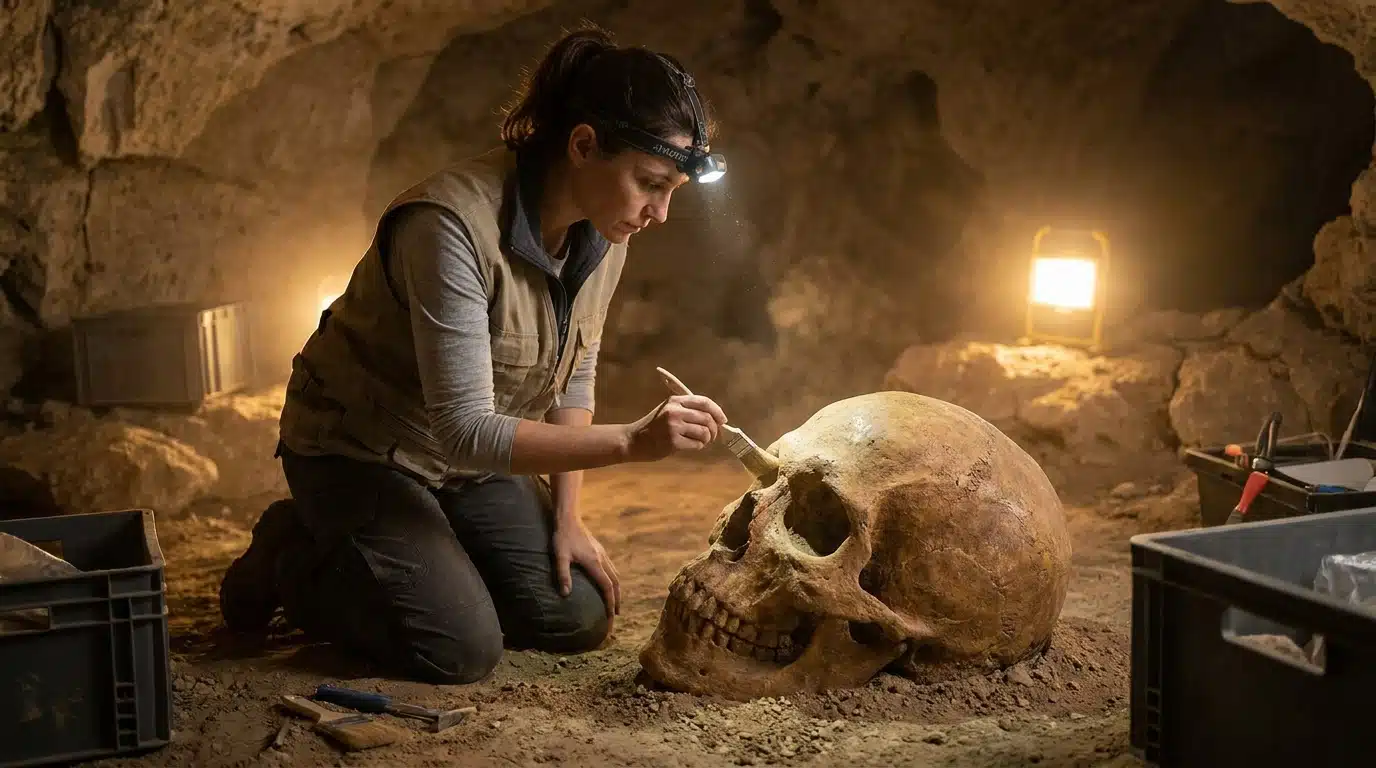
To fully understand the context of Nephilim DNA, we have to look at the physical clues left behind across the globe. During the 19th and early 20th centuries, newspapers across North America routinely reported on the discovery of massive human skeletons found inside ancient burial mounds. These skeletons often measured between seven and ten feet tall, featuring double rows of teeth and elongated skulls. Many of these reports claimed the bones were shipped off to major museums, never to be seen again.
If these skeletons were real, they would be the ultimate key to solving the mystery of Nephilim DNA. Imagine being able to extract ancient DNA from a ten-foot skeleton found in an Ohio burial mound. We would finally have the blueprint to compare against our modern ‘ghost lineages’. Unfortunately, many of these historical skeleton discoveries have been lost to time, poorly preserved, or locked away in private collections, making official scientific study almost impossible.
However, the ruins left behind by ancient civilizations still stand as silent witnesses. Megalithic structures like Baalbek in Lebanon, Sacsayhuamán in Peru, or the massive stone works of ancient megalithic builders feature blocks of stone weighing hundreds of tons, carved and placed with absolute precision. Ancient legends consistently attribute these mind-boggling constructions to giants. If these builders possessed unique physical strength and intelligence, is it possible their descendants carried these traits forward through Nephilim DNA?
Separating Mainstream Genetics from Radical Theories
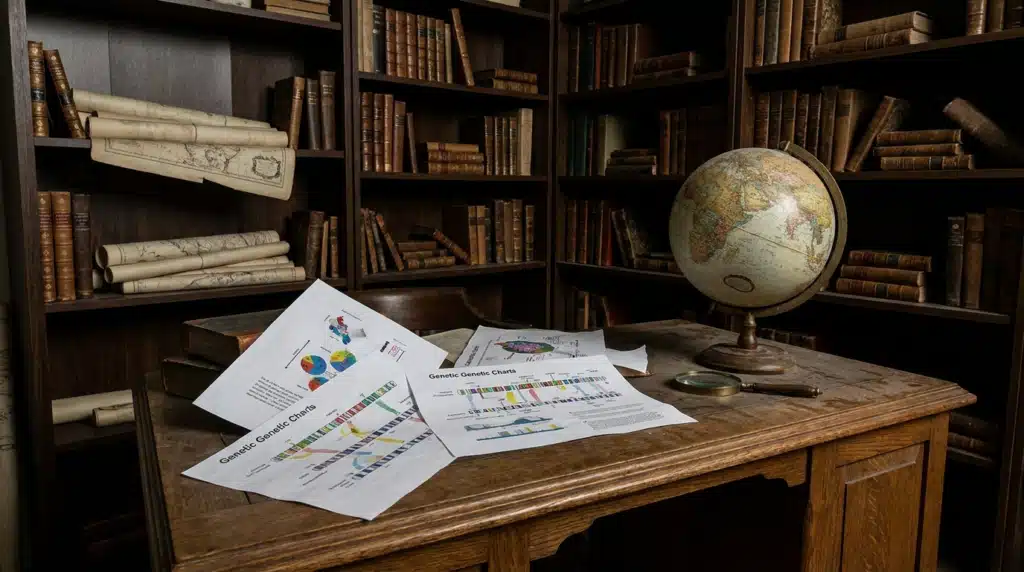
As much as I love exploring these theories, it is vital to keep our feet on the ground and look at what mainstream science actually says. When geneticists discover a Ghost Lineage in Human DNA, they do not immediately jump to biblical giants. Instead, they look for logical, evolutionary explanations. They hypothesize that ancient Africa, Europe, and Asia were once home to dozens of different hominid species that lived alongside early humans, occasionally interbreeding before dying out.
According to mainstream science, the idea of Nephilim DNA is a misinterpretation of these natural, complex evolutionary processes. Scientists point out that ancient human migration, isolated geographic pockets, and natural genetic mutations are more than enough to explain the unexplained gaps in our genome. They argue that calling a ghost lineage ‘Nephilim DNA’ is simply putting a mythological label on a standard, albeit mysterious, evolutionary occurrence.
But even with this skeptical view, we cannot ignore the sheer scale of what we do not know. The fact that modern geneticists admit there are entire hominid species we know absolutely nothing about shows how incomplete our understanding of human history really is. Whether you call these unknown ancestors ‘archaic hominids’ or ‘Nephilim’, the reality remains the same: we carry the physical remnants of a mysterious, highly advanced, or unique past inside our very cells.
Can You Test Your Own Genome for Mysterious Ancestry?
If you are like me, you probably want to know how you can check your own genetic makeup for these anomalies. While commercial ancestry tests like 23andMe or AncestryDNA won’t have a specific category labeled ‘Nephilim DNA’, there are ways to look for unusual markers. Many people download their raw genetic data from these platforms and upload it to third-party tools like GEDmatch or Promethease, which allow for a much deeper, more detailed analysis of ancient genetic markers.
When analyzing your raw data, look for unusually high percentages of archaic DNA or unassigned regions that do not match modern geographic populations. Some people who do this find surprisingly high connections to ancient Denisovan or Neanderthal markers, while others find strange, unmapped segments in their non-coding regions. While this won’t give you a definitive answer on whether you carry Nephilim DNA, it is a fascinating way to connect with the deep, mysterious history of the human family tree.
The search for our origins is far from over. As genetic sequencing technology continues to leap forward, and as archaeologists uncover more ancient remains, we are bound to find more pieces of this incredible puzzle. Whether these unexplained genetic markers are eventually proven to be Nephilim DNA or simply a new branch of the human family tree, they remind us of one undeniable truth: we are far more complex, mysterious, and connected to the ancient past than we ever dared to imagine.