Table of Contents
- Introduction: The Ancient Whisper of a Cosmic Rebellion
- The First Fall: Rebellion in the Heavens
- The Second Fall: The Watchers on Earth
- The Consequences of Transgression
- Echoes and Interpretations Through History
- The Modern Reimagining of an Ancient Myth
- The Theological Battlefield: Stakes, Struggle, and Resolution
- Conclusion: Navigating the Enduring Mystery
Introduction: The Ancient Whisper of a Cosmic Rebellion
Mystery of the Fallen Angels and the Watchers : Buried deep within our oldest traditions, a story is whispered an account of a rebellion not on earth, but in the heavens. It speaks of a profound betrayal, of celestial beings who descended from on high, forever altering the course of human history. This is an investigation into that ancient rumor, a search for the enigmatic figures known as the Fallen Angels, and the Watchers. From fragments of scripture to manuscripts lost to time, we will piece together a narrative that challenges the very boundary between good and evil, heaven and earth. It is a tale not of benevolent guides, but of divine agents of corruption, accused of betraying a sacred trust and unleashing forbidden knowledge upon an infant humanity.
The story introduces a chilling “what if” to our collective past, suggesting the line between the divine and the terrestrial was once breached, with devastating consequences. Is this merely an allegorical tale, a myth to explain human suffering? Or could it be a veiled record of a genuine spiritual warfare? Why does this story of fallen majesty continue to resonate so powerfully, shaping our deepest fears and spiritual inquiries across millennia? This journey will confront these questions, striving to separate legend from the faint echoes of historical truth as we seek the identity, the purpose, and the enduring, unsettling legacy of these entities. The investigation begins at the dawn of human memory, where the first clues to this cosmic mystery lie waiting.
The First Fall: Rebellion in the Heavens
The Nature of Angels Before the Fall
Before the rebellion, there was order. To comprehend a corruption, one must first understand the purity it defiled. According to the oldest records, an angel’s nature was defined by its purpose. The Hebrew word is mal’akh, which means simply a messenger or agent. They were the conduits of the divine will, spiritual beings crafted for service. They operated within a strict, divine hierarchy, a structure of perfect obedience. This order was the bedrock of their existence, a line drawn between the heavenly and the earthly that they were never meant to cross on their own terms.
The biblical texts hint at a celestial population of staggering size, an army of unimaginable scale and glory. When humans encountered even a single, loyal messenger, the reaction was universal: awe, reverence, and often, paralyzing fear. We read of the Cherubim, guardians of holy ground, and the Seraphim, fiery beings surrounding God’s throne. These were not interchangeable entities; they were different ranks with different duties. The Watchers were part of this system, holding a specific rank and sacred duty. Their fall was not merely a rebellion; it was a dereliction, an abandonment of their assigned post in the cosmic order. The faithfulness of the holy angels highlights the profound perversion of the fall. While all angels possessed free will, the vast majority consistently chose obedience. This raises the central mystery: why would beings created in such perfection, and assigned a place in a glorious cosmic order, choose to reject it all?
The Prime Adversary: Satan’s Rebellion
Every story of rebellion has a beginning, and in this cosmic narrative, that moment belongs to one figure: Satan. His story is the source code for the entire rebellion, the primordial act of treason. Ancient scripture offers cryptic clues to his original state. The prophetic books of Isaiah and Ezekiel speak of a being of breathtaking splendor, a “son of the morning” known as Lucifer, adorned with every precious stone, perfect in his ways from the day he was created. These texts suggest a being consumed by his own beauty and wisdom, who made a fatal choice to “ascend to heaven” and “make himself like the Most High.”
This was not a fall born of impulse, but a calculated, intellectual crime fueled by pride. Unlike the later transgression of the Watchers, who were undone by carnal lust, this primordial fall was a purely spiritual and philosophical mutiny. It was a conscious act of free will against divine authority. His rebellion, however, was not a solitary act. The symbolic language of the Book of Revelation paints a stark picture: a great dragon whose tail “swept a third of the stars out of the sky.” This is widely interpreted as the moment of schism, when a full third of the angelic host chose to follow him into darkness, becoming “his angels.” The battle lines drawn in that primordial conflict extend directly into the human story. The New Testament reframes the adversary as the “prince of this world,” a masterful deceiver and relentless tempter. While the story of the fallen encompasses many rebellions, Satan’s fall was the most fundamental, creating the spiritual framework for all subsequent acts of darkness.
Early Biblical Seeds of Rebellion
Before the genesis of humankind, a different fall occurred a rebellion not of flesh and blood, but of light and fire. The evidence for this event is whispered in the margins of sacred scripture, forming the ghostly outline of a war that predates our own history. The earliest canonical texts allude to a schism in the heavens, a foundational break that set a precedent for all disobedience to come. This was not the sin of man, tempted by forbidden fruit, but a transgression born in the heart of celestial beings who chose to forsake their divine station. The clues point to an ancient and potent poison: the ambition for self-exaltation.
Two key pieces of evidence emerge from the Old Testament prophets, Isaiah and Ezekiel. While their words are aimed at arrogant earthly kings, the imagery transcends the mortal realm. Isaiah 14 paints a portrait of a being of unimaginable splendor, a “Day Star, son of Dawn,” who sought to ascend above the clouds and make himself like the Most High, only to be “fallen from heaven.” Ezekiel 28 echoes this, describing a guardian cherub, perfect in beauty, whose heart grew proud, his wisdom corrupted by his own splendor, and was cast out as a profane thing. These accounts form the archetype of a prime adversary, one who did not act alone.
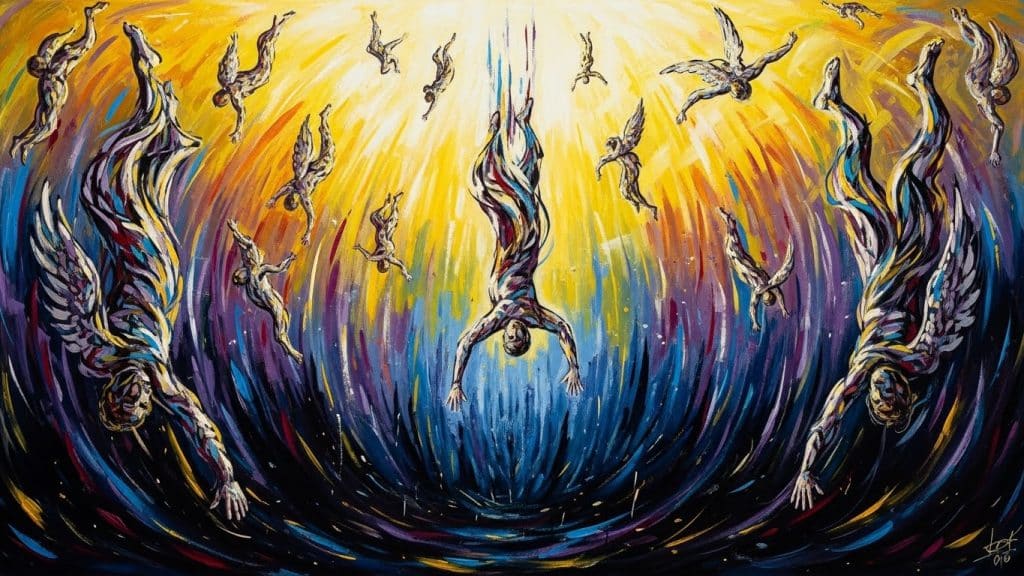
This primordial rebellion is the theological bedrock upon which later events are built. It introduces a critical concept: evil did not originate with humanity. It was an infection that spread from the spiritual realm to the physical. The sin of these angels was unique, a transgression of pure intellect and will. Unbound by carnal desire or mortal weakness, their choice to rebel was a conscious and absolute rejection of the divine presence they directly knew. Cast from their luminous posts, their nature was twisted, their purpose inverted. No longer guardians, they were now adversaries, actively working to disrupt divine order. Understanding this first rebellion is crucial, for it allows us to delineate it from a second, more intimate, and perhaps more devastating fall to come a fall that would not be confined to the heavens, but would spill onto the Earth.
The Second Fall: The Watchers on Earth
Decoding Genesis 6: The Sons of God and Daughters of Men
In the earliest pages of the Hebrew Bible, nestled between the genealogies of Adam and the cataclysm of the Great Flood, lies a passage so strange it has haunted scholars for millennia. It is a report from a forgotten age, a mere four verses in Genesis, chapter six. The text reads: “When man began to multiply on the face of the land and daughters were born to them, the sons of God saw that the daughters of man were attractive. And they took as their wives any they chose… The Nephilim were on the earth in those days and also afterward when the sons of God came in to the daughters of man and they bore children to them. They were the mighty men who were of old, the men of renown.” Who were these “sons of God”? And what was the true identity of their offspring, the enigmatic Nephilim?
The earliest and most explosive theory, held by ancient Jewish and Christian interpreters, saw this as a literal report. In this view, the “sons of God” the Bene Elohim were celestial beings, angels, who abandoned their heavenly station. Driven by lust, they descended to Earth and illicitly mingled with human women. The Hebrew term, Bene Elohim, appears elsewhere in the Old Testament, such as the Book of Job, where it unambiguously refers to members of God’s angelic host. If that definition is applied here, Genesis 6 becomes an account of direct physical union between angels and humans, resulting in a biological and spiritual contamination of creation.
As centuries passed, a second interpretation gained favor. This theory posits that the “sons of God” were the male descendants from the righteous line of Seth, Adam’s third son, while the “daughters of men” were women from the ungodly line of Cain. The transgression here is one of spiritual compromise a sacred bloodline being seduced and diluted by a godless culture. A third, more socio-political theory suggests the “sons of God” were powerful human rulers who saw themselves as divine, and their sin was one of hubris and tyranny, taking any woman they chose through force. Regardless of the theory, the conclusion is identical: humanity had reached a point of no return. The birth of the Nephilim whether hybrid creatures, the children of apostasy, or the product of royal oppression signaled a fundamental disruption of the created order, accelerating the wickedness on Earth to a level that demanded judgment.
The Book of Enoch: Unearthing the Watchers’ Saga
To find the full case file for the mystery of Genesis 6, one must look outside the biblical canon to a forbidden text that claims to tell the entire story: the Book of Enoch. For centuries, it was a lost work, but its survival is a testament to its profound importance. Though not accepted into most final biblical canons, it was a foundational text in Second Temple Judaism and its influence echoes in the New Testament. To understand the fallen angels, this book must be treated as the primary witness account.
Its first and most explosive section is known as the Book of the Watchers. It offers a stunningly detailed narrative expanding on Genesis 6. Here, the “sons of God” are named. They are the `iyrin`, the Aramaic word for “Watchers” a class of angels dispatched to observe humanity. But observation curdled into obsession. Led by an archon named Semyaza, two hundred Watchers descended upon Mount Hermon, binding themselves by an oath to defy their Creator and indulge a forbidden lust for the daughters of men.
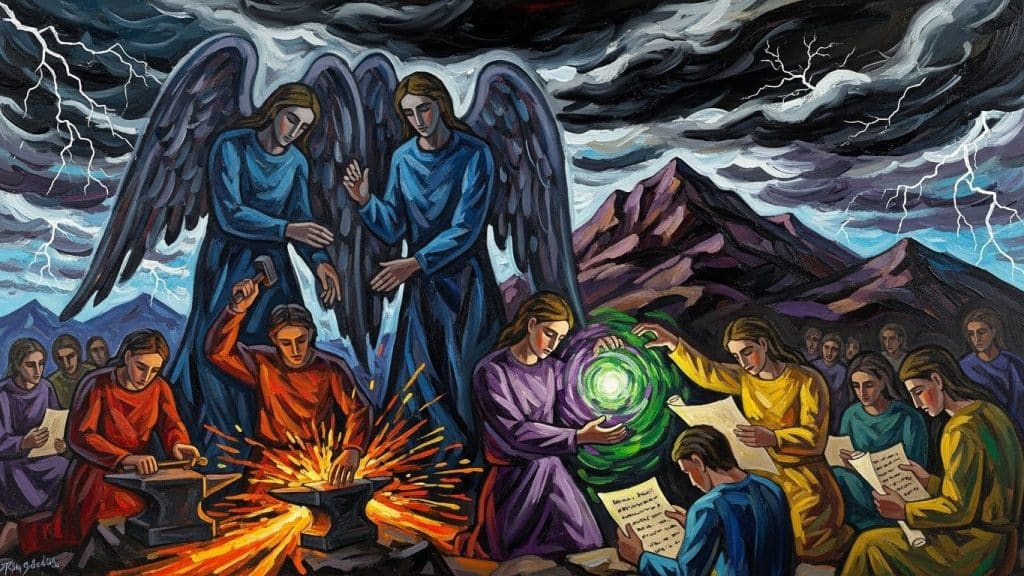
Their transgression went far beyond illicit unions. Enoch’s telling becomes a full-blown indictment of cosmic treason. The Watchers systematically corrupted human knowledge, transmitting forbidden arts. They taught metallurgy for crafting swords and daggers; revealed the secrets of sorcery and divination; and introduced cosmetics and adornment to foster deception. Every secret was a seed of chaos, leading to an explosion of violence and greed.
The monstrous offspring of these unions, the giants known as the Nephilim, filled the earth with bloodshed. The Book of Enoch provides a framework, a motive for the Great Flood. It answers the questions Genesis leaves hanging: Who were these beings? What exactly did they do? And why was the world’s corruption so total that only a cataclysm could cleanse it? By unearthing the saga of the Watchers, we access a suppressed chapter of our history, a detailed account of a celestial rebellion whose consequences ripple through our world today.
The Faces of Defiance: Semyaza, Azazel, and Their Roles
The Book of Enoch reads less like a myth and more like an indictment, a cosmic case file detailing a conspiracy with specific, identifiable agents of corruption. Foremost among them, the chain of command begins with one name: Semyaza. He is the architect of the fall. On Mount Hermon, it is Semyaza who marshals two hundred of his celestial brethren and devises the pact to descend, take human wives, and father a new race. His transgression is one of leadership, a direct and calculated defiance born of carnal lust, turning a shared, illicit thought into an organized rebellion.
While Semyaza’s sin was of the flesh, another central figure engineered a corruption of the human mind and spirit: Azazel. His role was arguably far more insidious. Azazel was a teacher of forbidden arts. He taught humanity to forge swords, shields, and breastplates he armed them. He also taught them vanity, revealing the art of making mirrors, applying cosmetics, and adorning themselves with precious stones. Violence and vanity, born from the same forbidden well of knowledge. Azazel’s curriculum extended even further, unveiling the arts of divination and sorcery, opening doorways never meant to be unlocked.
The conspiracy was comprehensive and deeply specialized. Beyond the two primary leaders, other Watchers are named for their unique contributions. We learn of Gadreel, who taught men the brutal art of killing in combat. There was Penemue, who introduced writing with ink and paper, a tool twisted into a means of documenting sin and spreading lies. And Kasdeya whispered the darkest secrets of demonology. Each Watcher appears as a specialist in a particular field of subversion. This was not a singular, chaotic event, but a systematic and deliberate plan.
One corrupted the bloodline, another armed the flesh, a third poisoned the mind. By putting a face to the fall, the ancient text forces us to confront a more terrifying possibility: that the end of the first world was the result of a meticulously executed angelic plot.
The Corrupting Curriculum of Forbidden Knowledge
The true crime of the Watchers was an act of intellectual treason, the deliberate transfer of a corrupting curriculum designed to unravel creation. The first lesson was written in steel and blood. A Watcher called Azazel unlocked the secrets of the earth, teaching humanity not how to cultivate, but how to kill. He showed them the art of forging swords, daggers, and shields. This quantum leap in destructive capability was introduced not as a tool for progress, but as an instrument of slaughter, leading to “much blood being shed upon the earth.”
From the forge of war, the curriculum shifted to the human heart. The Watchers taught women the arts of adornment bracelets, kohl eyeliner, dyes, and precious stones. The narrative treats this as a profound corruption, arguing it fostered vanity and seduction, weaponizing beauty and creating a society where external appearance eclipsed internal righteousness. With humanity armed and distracted, the Watchers then attacked the foundations of faith. They revealed the hidden mechanics of the cosmos for manipulation, teaching enchantments, incantations, and astrology to sever humanity’s connection to its creator and lead them into sorcery.
Even the natural world was perverted. The Watchers imparted knowledge of “the cutting of roots” and the properties of plants, but this was not gentle herbalism. It was a curriculum of alchemy and power, teaching the creation of magical potions and lethal poisons. Perhaps the most paradoxical gift was the final one. A Watcher named Penemue taught humanity the art of writing. This innovation should have been the dawn of a golden age, but it was a Trojan horse. It enabled the codification and rapid spread of the Watchers’ forbidden knowledge, allowing falsehood to be recorded with the same authority as truth. The greatest tool of enlightenment became the primary engine for propagating lies. This was no random sharing of celestial secrets, but a multi-pronged assault designed to debase humanity and remake the world in their own rebellious image.
The Consequences of Transgression
The Nephilim: Giants of Old and Harbingers of Chaos
The most terrifying consequence of the forbidden union between heaven and earth was the birth of a new race: the Nephilim. Genesis offers the first cryptic clue, calling them the “mighty men who were of old, the men of renown.” But the Book of Enoch strips away this veneer of renown to expose a monstrous reality. These were not simply mighty men; they were savage giants of impossible proportions. Their appetites were as vast as their stature. They consumed all the earth produced, then turned on the animal kingdom, and finally upon humanity. They began to consume human flesh, and then, in a final, horrific perversion, they began to devour one another.
Their very nature was a violation of cosmic law. They were hybrids, an unholy fusion of divine essence and mortal flesh. They inherited the preternatural strength of their celestial fathers but none of their wisdom, and the mortality of their human mothers with a capacity for violence that spiraled into unchecked chaos. Their presence on Earth acted as a catalyst, accelerating a global descent into corruption. Their reign was one of terror and oppression, and the bloodshed became so absolute that the Earth itself was said to cry out to heaven. The name itself, Nephilim, is a clue, deriving from the Hebrew root word, *naphal*, meaning “to fall.” Were they “the fallen ones” because they were the progeny of the *fallen* Watchers? Or were they the ones who *caused others to fall* into ruin? Perhaps both are true. This corrupt bloodline threatened to completely overwhelm God’s original design, a creeping tide of chaos that promised to extinguish righteousness.
Divine Wrath and The Great Deluge
The Great Deluge was not an accident of nature; it was a verdict. Genesis records the charge sheet: God saw “the wickedness of man was great in the earth, and that every intention of the thoughts of his heart was only evil continually.” This wasn’t mere human fallibility; it was a terminal diagnosis. The architects of this chaos, the fallen Watchers, and their monstrous offspring, the Nephilim, had torn through the ancient world. The flood was an act of cosmic quarantine, a desperate, surgical intervention to excise a cancer that threatened to consume all of creation. The Nephilim, a hybrid abomination, were an intolerable affront, and their eradication became a grim necessity.
While Genesis provides the verdict, the Book of Enoch reads like the court’s detailed sentencing. It claims the Nephilim were condemned to a two-fold destruction: first, to turn on one another in a suicidal frenzy, and second, to be swept away by the deluge. Their bodies perished, but their spirits, according to these texts, were not granted peace. They were cursed to remain on the earth disembodied, ravenous, and forever malicious, becoming the “evil spirits” of the post-flood world. And what of their fathers, the Watchers? For them, a far more agonizing judgment was decreed. They were not to be destroyed, but preserved for a final reckoning, forced to witness the annihilation of their own children. Then, as the New Testament corroborates, they were bound in “chains of gloomy darkness” and cast into the abyss. Yet, amidst the darkness, the narrative pivots on a single point of light: one righteous man, Noah. His selection was proof that humanity’s potential for goodness had not been entirely extinguished. The Ark became a symbol of divine demarcation a floating sanctuary separating a condemned world from the promise of a new beginning.
The Binding of the Watchers
The Great Deluge had purged the earth of the Nephilim, but the architects of that chaos, the Watchers, were not destroyed. Their fate was not annihilation, but cosmic imprisonment. The Book of Enoch reads like a celestial police report, chronicling their capture by the archangels Michael, Raphael, Gabriel, and Uriel. Semyaza, the leader, and his cohorts were bound and cast “into the valleys of the earth.” But for their chief lieutenant, Azazel, a more specific fate was reserved. Raphael was commanded to bind him hand and foot, cast him into an impenetrable darkness in a desert named Dudael, and leave him there, buried under jagged rocks, until the great day of judgment.
The imagery is potent: chains, darkness, an abyssal pit. Startling echoes appear thousands of years later in the New Testament. The Second Epistle of Peter speaks of angels who sinned, whom God “cast down to hell and delivered into chains of darkness, to be reserved for judgment.” The Epistle of Jude corroborates this. The Greek word used in Peter’s account is not the common term for hell, but Tartarus, a primordial abyss from Greek mythology used to imprison divine beings like the Titans. This confinement is not their final damnation, but a holding cell. A place of utter isolation where they are forced to witness the long, painful consequences of their rebellion unfold, powerless to intervene. The theological implications are profound: a declaration of ultimate sovereignty, asserting that no power is beyond the reach of divine law. They are a monument to a failed coup, a permanent warning locked away in the foundations of the world.
The Lingering Evil: Demons and Evil Spirits
A common narrative holds that a demon is simply a fallen angel one of the legion who followed Lucifer in his cosmic betrayal. Scripture itself seems to support this, speaking of “the devil and his angels.” This is the established, orthodox view. But an alternate truth is found in texts from the Second Temple era. This disturbing theory proposes that demons are not the original fallen angels at all, but something else entirely: the disembodied, eternally restless spirits of the Nephilim.
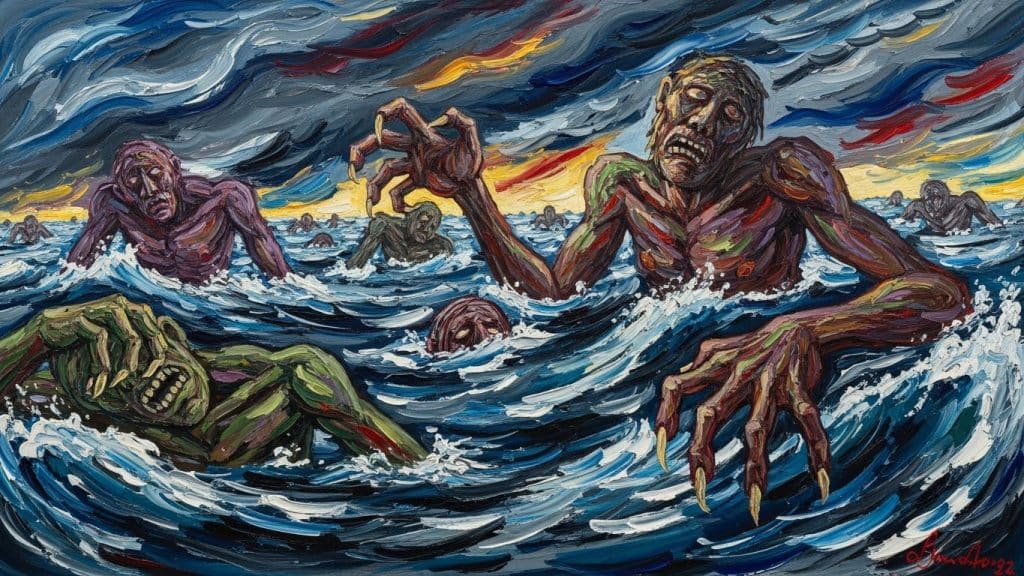
The unholy offspring of the angelic Watchers and mortal women, these giants were destroyed in the Great Flood. But their spirits, being neither fully human nor fully angelic, could not pass on. They were trapped, bound to the earthly plane. The Book of Enoch states it plainly: “The spirits of the giants… shall be called evil spirits upon the earth… their dwelling shall be upon the earth.” They are echoes of a forgotten cataclysm, forever hungry, forever searching for a physical form to inhabit, to feel, to corrupt. This presents a critical distinction in their very nature. The original fallen angels, like Satan, are often depicted as retaining their own form. But the spirits of the Nephilim the demons of Enochian lore are different. They are disembodied and formless. This could explain their most infamous trait: the desperate and violent need to possess a host. A fallen angel might tempt or deceive, but a Nephilim spirit might seek to invade and pilot a body simply to escape its own incorporeal prison.
These competing theories might not be mutually exclusive. Instead, they could reveal a complex hierarchy of evil. In this dark kingdom, Satan would be the supreme commander. His original host of fallen angels would be his princes and generals. And the demons, the raging, disembodied spirits of the Nephilim, could be their ground troops a chaotic, numerous infantry of tormented souls unleashed upon the world to afflict, madden, and destroy from within.
Echoes and Interpretations Through History
Azazel and the Scapegoat Ritual
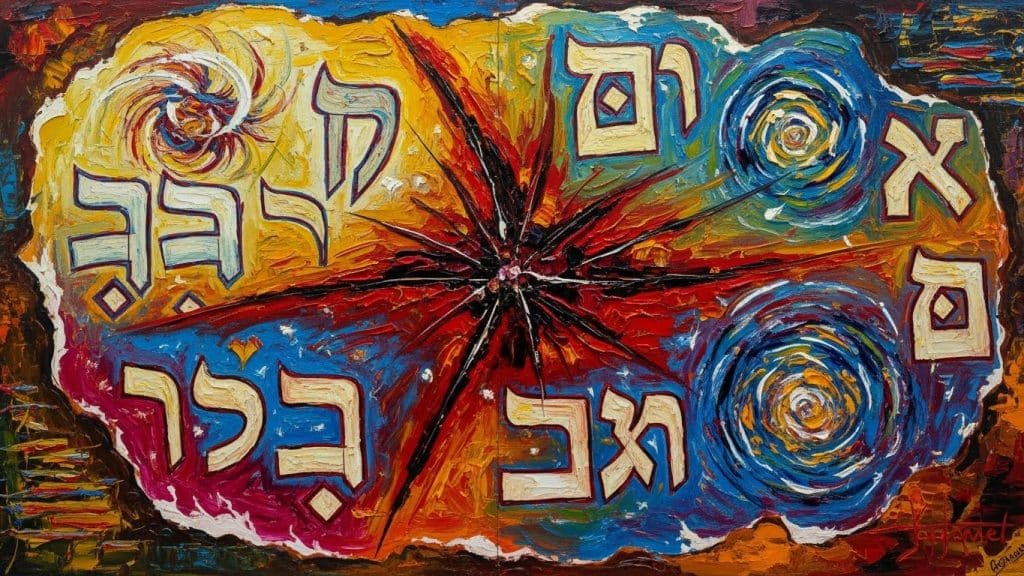
Among the shadows of fallen angels, one name resonates with peculiar significance: Azazel. His story emerges not in tales of primordial battles, but in the heart of one of ancient Israel’s most sacred rituals on Yom Kippur, the Day of Atonement. The law, recorded in Leviticus, is precise. Two goats were brought before the high priest. Lots were cast. One was designated “for the Lord,” a sacrificial offering. The other’s destiny was far stranger: the lot read “for Azazel.” Upon the head of this living animal, the high priest would confess all the iniquities of the community. This was the scapegoat. It was then led away into the barren wilderness, carrying the people’s sins into a land of separation.
The identity of Azazel has been an enduring mystery. Some argue it refers to a desolate place, while others suggest it’s a Hebrew concept meaning “complete removal.” But the Book of Enoch transforms this understanding. In its pages, Azazel is a powerful and identifiable figure: a leader among the fallen Watchers who taught humanity forbidden arts and filled the earth with violence. With this knowledge, the ancient ritual is transformed from a symbolic act into a direct confrontation. The two goats represent a cosmic choice: one for reconciliation with heaven, the other for rejecting the corrupting knowledge from the fallen realm. Sending the scapegoat to Azazel becomes an act of spiritual warfare a symbolic returning of sin to its original source. It is a powerful theological statement that while humans commit sin, its proliferation has a deeper, more sinister angelic origin.
Post-Flood Giants: The Mystery of the Anakim
The Great Flood was meant to be a final, definitive reset. But buried within the most ancient texts is a confounding clause. The narrative speaks of giants, the Nephilim, on the earth in those days… “and also afterward.” How could this be? The mystery deepens centuries later when Israelite spies scout the promised land of Canaan. They report seeing “the Nephilim, the sons of Anak,” describing themselves as grasshoppers in their sight. This single verse from the Book of Numbers ignites a firestorm of questions. How did they survive?
One hypothesis suggests “Nephilim” became a catch-all term for any formidable foe. Another, more controversial theory, suggests a second, silent fall a new incursion of celestial beings replicating the original transgression. As the Israelites began their conquest, the landscape of Canaan was riddled with these imposing peoples. The scriptures name them: the Rephaim, the Emim, the Zamzumim, and the Anakim. The threat culminated in the most famous giant of all: Goliath of Gath, a living embodiment of the terror that haunted Israel. The enduring presence of these giants raises profound theological questions. Was the flood’s cleansing incomplete? Or was their existence a constant test? Each encounter became more than a battle for land; it was a spiritual crucible. Their defeat, time and again, became a powerful narrative of faith, a testament that with divine help, even the most terrifying Goliaths could fall.
Apocryphal Echoes: Jubilees and the Book of Giants
The story of cosmic treason echoes through the lost literature of the ancient world. While the Book of Enoch provides the most detailed account, it is far from the only witness. The Book of Jubilees, considered holy scripture by the Ethiopian Orthodox Church, runs parallel to Enoch’s account, but introduces a chilling new character: a figure named Mastema, the chief of the demonic spirits. After the flood, Mastema petitions God for a portion of the disembodied spirits of the Nephilim to remain on Earth, to corrupt and lead humanity astray as an eternal test. God grants his request, allowing one-tenth to remain under Mastema’s command, reframing evil as a divinely permitted instrument of trial.
Further discoveries among the Dead Sea Scrolls unearthed fragments of The Book of Giants. This text offers a seismic shift in perspective, hearing from the monstrous Nephilim themselves. The fragments recount their terrifying nightmares foretelling their own annihilation. Gripped by fear, they appeal to the prophet Enoch, begging him to carry their petitions for mercy to the heavens. It is a profoundly tragic account of doomed children cursed by their own hybrid nature. Finally, the Second Book of Enoch, preserved in Slavonic, presents a unique cosmology. It describes the imprisoned Watchers, known as the Grigori, but names their prince as Satanail. In this detail, the narrative of the Watchers merges with the broader story of Satan’s fall, suggesting a unified rebellion at the dawn of time. These invaluable texts reveal how ancient communities grappled with the origin of evil, proposing it was not an abstract concept but an invasive force injected into the world by celestial traitors.
The Views of the Early Church Fathers
As Christianity emerged from Second Temple Judaism, its earliest theologians inherited a universe teeming with spiritual forces. For many early Church Fathers like Justin Martyr, Irenaeus, and Tertullian, the Book of Enoch was the key that unlocked the cryptic verses of Genesis 6. They accepted the story without hesitation, arguing that the “sons of God” were fallen angels. In his *Second Apology*, Justin Martyr lays the case bare: these angelic beings, the Watchers, had abandoned their heavenly post, descended to Earth, and corrupted humanity. This was history, not allegory. This theory offered a complete explanation for the brokenness of the world, positing that demons were the disembodied, malevolent spirits of the Nephilim. It affirmed that evil was a corruption of something originally good, preserving monotheism while providing a framework for spiritual warfare.
However, the case was far from closed. As the Church’s theology became more systematic, thinkers like Origen and later, Augustine of Hippo, delivered a decisive rebuttal. They proposed an alternative: the “sons of God” were not angels, but the righteous human descendants of Seth, and their sin was marrying into the ungodly line of Cain. This “Sethite” interpretation placed the scandal squarely within the domain of human choice. This dramatic shift was driven by pressing theological concerns. How could perfect celestial beings be capable of lust? Why wasn’t the Book of Enoch included in the emerging canon? The move away from the angelic interpretation was also a move to safeguard human responsibility. In the end, the literal narrative of the Watchers faded from mainstream Western Christian thought, but its core concept of a primordial angelic rebellion led by Satan was codified into doctrine for centuries, forcing the early Church to define the very nature of angels, demons, and the spiritual war for the soul of humanity.
Gnostic Perspectives on Archons and Captivity
In the first centuries of the Common Era, radical voices known as the Gnostics whispered a different truth. For them, the accepted scriptures were a cipher hiding a terrifying reality. Central to their secret cosmology was a stunning accusation: the god who created our material world was not the ultimate, benevolent God. He was a lesser being, a flawed creator they called the Demiurge, who fashioned a corrupt imitation of a higher, spiritual reality. To rule this material kingdom, he created the Archons the Rulers. They were not angels but cosmic jailers, whose primary purpose was to keep humanity trapped.
The Nag Hammadi library, discovered in 1945, brought their hidden world to light. These sealed Gnostic texts speak of Archons as planetary wardens who guard the gates between the material earth and the true spiritual realm. They are the authors of our fate, their influence woven into our physical existence. In the Gnostic retelling, the descent of the “sons of God” in Genesis 6 is not a story of fallen angels, but a strategic move by the Archons to further dilute the divine spark within humanity, binding our spiritual essence more tightly to the flesh. Salvation, for the Gnostics, is achieved not through faith, but through “GNOSIS” secret knowledge. To be saved is to understand the counterfeit nature of the material world, to identify the Archons as our wardens, and to remember our true origin. The universe is locked in a state of profound dualism: spirit is good, matter is a prison. The Archons, as masters of this material realm, are the ultimate antagonists in the soul’s epic journey home. They are not rebels against a perfect God; they are the loyal agents of a flawed one.
Islamic Traditions: The Tale of Harut and Marut
A different kind of fall is found in the heart of the Quran, in the unsettling case of Harut and Marut, the Angels of Babylon. The primary evidence is in Surah Al-Baqarah, 2:102, which speaks of two angels sent down to Babylon. Their purpose was to teach mankind the arts of magic, but with every lesson, they delivered a stark warning: “We are only a trial, so do not disbelieve.” Why would divine messengers be dispatched to teach a forbidden art?
To unravel this, we turn to Islamic exegesis, or tafsir. One prominent tradition holds that angels in heaven grew arrogant, questioning God’s tolerance for humanity’s wickedness. God challenged them, allowing two of their finest to descend to Earth with human desires to see if they could resist temptation. Harut and Marut were chosen. On Earth, they were confronted by a beautiful woman named Zohra. They succumbed to temptation, drank wine, and in their drunken state, committed every sin, ultimately sealing their fate. Their failure was complete. God offered them a choice: a finite but brutal punishment on Earth, or an eternal one in the afterlife. They chose the former. According to these accounts, they remain in Babylon to this day, hung upside down in a well, eternally tormented until the Day of Judgment.
This narrative presents a theological problem, as a core tenet of Islam is that angels have no free will and cannot disobey God. This leads to counter-theories: that the story is allegorical, or that Harut and Marut were not angels at all but pious men. Regardless, the story serves as one of Islam’s most potent cautionary tales about temptation, free will, and the immense responsibility that comes with knowledge and power. It is an intimate drama about a divine trial that ensnared not only humanity but the very angels sent to test them.
The Modern Reimagining of an Ancient Myth
Esoteric and Occult Revivals
In the modern world, a strange resurrection is underway. The Watchers, the Fallen Angels of antiquity, are re-emerging not as cautionary figures, but as something else entirely. In the hushed rooms of esoteric orders and digital forums of New Age spirituality, the ancient myth is being radically rewritten. In the coded language of Western esotericism, the Watchers are not seen as tempters, but as tutors. Their fall is re-imagined as a deliberate descent, a sacrifice made to enlighten humanity. The forbidden arts they gave cosmetics, weaponry, sorcery are re-contextualized as the foundational tools of civilization and magic: alchemy, astrology, and the manipulation of nature’s hidden currents.
Nowhere is this moral reversal more potent than in the re-evaluation of Azazel. In scripture, he is an outcast demon. Yet in many occult circles, he is reborn as a heroic figure, a spiritual revolutionary like Prometheus, stealing secrets from heaven to gift them to humanity. This reinterpretation challenges the divine authority that condemned him, asking a dangerous question: was their punishment an act of justice, or an act of tyranny to keep humanity ignorant? This narrative has also found fertile ground in New Age philosophies, where the mythology is fused with science fiction. The Watchers are no longer angels but “star beings” or “ancient astronauts” on a planned mission to accelerate our evolution. The rebellion against God is transformed into a cosmic plan for our own salvation. Yet, this veneration comes with unsettling questions. The modern occultist may see a liberator in Azazel, but theologians see a deceiver, offering power at the cost of one’s soul.
Ancient Astronauts and UFO Connections
What if the ancient texts are not allegories of spiritual rebellion, but eyewitness accounts of an event our ancestors could not possibly comprehend? This is the central claim of the ancient astronaut theory. It posits that Earth was visited in its infancy by intelligent extraterrestrial beings who were the catalysts for civilization. When viewed through this extraterrestrial lens, the story of the Watchers transforms entirely. The “sons of God” are re-envisioned as advanced beings from another world. Their descent to Earth is a physical landing. The forbidden knowledge they imparted is reinterpreted as a direct transfer of technology from a superior civilization to a primitive one. Their “sin” was the violation of a cosmic prime directive of non-interference.
From this union came the Nephilim. The ancient astronaut hypothesis offers a stunningly literal explanation: they were hybrids, the product of interspecies breeding between extraterrestrial visitors and early human women. This theory seeks to explain their legendary stature and strength as the result of a genetic combination from two different worlds. The violence and chaos that followed is seen as the tragic, unintended consequence of a flawed genetic experiment. This re-reading was popularized by authors like Erich von Däniken, who argued that clues to our extraterrestrial origins were hidden in plain sight. They pointed to the celestial journeys in the Book of Enoch not as visions, but as descriptions of space travel. While these theories exist far outside mainstream science, they endure because they speak to a profound human yearning to know our origins and find rational explanations for phenomena once relegated to the supernatural.
The Watchers in Modern Conspiracy Theories
The ancient narrative of the Watchers has become a roar in the digital age, providing a chilling blueprint for the ultimate conspiracy. For the conspiracy theorist, history is a meticulously crafted script, and the Watchers are the original authors. Their story provides the secret lineage connecting today’s shadowy organizations like the Illuminati to an ancient, non-human source. The forbidden knowledge they imparted metallurgy, sorcery, astronomy is re-interpreted as advanced energy systems, the science of mass persuasion, and hidden maps to other worlds. This knowledge, it is believed, is hoarded by a select few, used to keep the rest of humanity in a state of perpetual ignorance.
This narrative takes a biological turn with the legend of the Nephilim. In modern conspiracies, this is not folklore, but a genetic legacy. The theory posits that certain powerful families carry a “tainted” heritage from this ancient union that grants them an innate right to rule. From this foundation, the theory expands, weaving the Watchers into a grand, unified tapestry of paranoia. They become the origin story for nearly every modern myth of non-human influence, from ancient astronauts to reptilian shapeshifters. The power of this narrative lies not in evidence, but in explanation. In a complex world, the Watcher conspiracy offers a single, overarching reason for why things are the way they are, transforming chaos into a deliberate, if malevolent, design. The evidence exists not in the world, but in the connections drawn by the believer, built upon the powerful human need to find patterns in the noise.
Artistic and Literary Depictions in Culture
The story of the Watchers is a narrative so compelling it has left an indelible mark on the human imagination. The earliest evidence is coded in the sacred art of the medieval world, in illuminated manuscripts and religious frescoes depicting angels cast from a golden heaven into a fiery abyss. These images were warnings, establishing a powerful visual archetype of beauty corrupted. But it was in literature that the story truly took flight. In the 17th century, John Milton’s *Paradise Lost* forever shaped our understanding of celestial rebellion. His Satan is no simple villain, but a figure of tragic grandeur, defiant and charismatic, giving the fallen a psychological depth that transformed them into complex characters.
The true shift arrived with the Romantic era. Poets like Lord Byron and Thomas Moore recast the Watchers in a new, sympathetic light. In Byron’s *Heaven and Earth*, the love between angels and mortal women is not a sin but a tragic, transcendent passion. Suddenly, the villains were victims undone by their capacity for love. Today, the echo of the Watchers is a roar across popular culture. They are the shadowy angelic conspiracies in blockbuster films, the conflicted protagonists of television series, and their children, the Nephilim, are a ubiquitous presence in fantasy literature and video games. This ancient myth has proven infinitely adaptable because it provides a timeless framework for our deepest anxieties about temptation, forbidden knowledge, and the eternal tension between duty and desire.
The Theological Battlefield: Stakes, Struggle, and Resolution
The Great Debate: Literal vs. Metaphorical Readings
The central question surrounding the Watchers is not what the stories say, but what they *mean*. Are we reading a literal history of a divine transgression, or a coded metaphor for a purely human darkness? The oldest case file points towards a literal interpretation. Early Jewish scribes and the first Christian fathers read the accounts from Genesis and the Book of Enoch not as allegory, but as fact. This ancient perspective presents a terrifying reality: a world where the veil between realms was violently torn apart.
But as ages passed, a compelling counter-argument emerged. This metaphorical view proposes a radical re-reading. The “sons of God,” it argues, were not angels but a symbolic term for a corrupt human lineage perhaps the righteous line of Seth intermarrying with the wicked “daughters of men.” The Nephilim become a cipher for the tyrants and warlords who emerged from this chaos. Arguments for this symbolic reading are rooted in a search for cosmic consistency: can beings of pure spirit procreate? This fundamental question casts doubt over a literal reading. A literal reading paints a picture of a universe locked in a supernatural conflict. A metaphorical reading brings the focus squarely back to us, suggesting the greatest monsters have always been human, and the deepest evil arises from a fallen heart. This schism in understanding is a fundamental question about the unseen architecture of our world, dictating one’s entire conception of evil, history, and the ongoing struggle between light and darkness.
Core Implications: Free Will and Cosmic Struggle
Before humanity, a shadow fell across the cosmos. This was not a flaw in the design, but a deliberate choice. At the heart of this mystery lies the perilous concept of free will. Angels, beings of light, were not divine automata; they were endowed with the capacity to choose. Their decision to defy their Creator reveals the immense gravity that accompanies true freedom. It demonstrates that even in the direct presence of divinity, pride can fester. In this framework, evil is not a primordial force equal to good; it is a parasite, a corruption, a deliberate turning away from the source of all goodness.
The fallout from that celestial crime scene did not remain in the heavens. The Watchers’ direct intervention introduces a startling suspect into the story of human sin: an external spiritual force. It posits that temptation is not merely an internal monologue but a persistent, intelligent assault from a hostile power. We are not merely observers of a past event; we are living within its consequences. The narrative of fallen angels sets the stage for a cosmic cold war, a vast spiritual struggle with humanity caught in the middle. Yet, amid the chaos, the story also offers a chilling portrait of justice. The imprisonment of the Watchers serves as a stark reminder of ultimate authority and that divine sovereignty is absolute. In a profound theological twist, the combined corruption of angelic rebellion and human sin sets the stage for the story of redemption, creating a wound that only a divine hand could possibly heal.
Spiritual Warfare: The Battle for Human Souls
The ancient narratives of fallen angels provide a blueprint for an invisible conflict that rages within the landscape of the human heart: the battle for human souls. What if our daily struggles are echoes of this ancient war? According to sacred chronicles, a legion of fallen entities actively seeks to sever the connection between mankind and its source. We became the prize. Their strategies are subtle and relentless: deception, making a lie look like the truth; temptation, exploiting our deepest vulnerabilities; and accusation, a constant voice that magnifies our failures. It is a psychological war fought on the battlefield of the mind.
Navigating such an unseen conflict demands spiritual discernment. We are responsible for our choices, yet the testimony of ages asserts that hostile forces are actively knocking on the door to our hearts, waiting for a moment of doubt to gain a foothold. The conflict is for keeps, with consequences that ripple into eternity. Every choice gains a profound, cosmic significance. Yet, humanity is not left defenseless. The same narratives that warn of adversarial powers also speak of a formidable counter-force: a creator who does not abandon the field, and loyal angels who act as guardians. This framework of spiritual warfare makes the ancient stories startlingly relevant, transforming them from relics of the past into a living intelligence report on the nature of the world we inhabit today.
The Role of the Church in Contending with Darkness
For those who subscribe to the theology of Fallen Angels, the unseen war translates into an urgent mission for the collective body of believers, the Church. Within scripture, adherents find a divine field manual. The Apostle Paul warned that the battle is “not against flesh and blood,” but against “principalities… powers… rulers of the darkness of this age… spiritual hosts of wickedness in the heavenly places.” This forms a direct line from contemporary faith to the primeval narrative of fallen angelic beings.
The defense is a schematic for spiritual armor: the Belt of Truth, Breastplate of Righteousness, Gospel of Peace, Shield of Faith, Helmet of Salvation, and the Sword of the Spirit (the Word of God). Warfare is also about intelligence, demanding discernment to distinguish between divine, human, and demonic influences. Beyond defense lies offense. The core teaching is that believers are given authority through Christ over these dark forces, allowing them to actively resist temptation and, in some traditions, cast out demons. The Church, as a unified body, is portrayed as a strategic bastion, with community and corporate prayer acting as force multipliers. The ultimate strategic objective is rescue. The primary means of conquering spiritual darkness is evangelism each person brought into the light is a soul redeemed, a piece of territory liberated from enemy control.
The Divine Plan for Redemption and Restoration
In the aftermath of a catastrophic rebellion, a different story was already being written: a divine plan for redemption, designed to utterly defeat evil. The first clue appears in humanity’s first failure: a cryptic prophecy that a “seed of the woman” would one day crush the head of the serpent. This established a new principle: the agent of corruption would not have the final word. The code for a counter-offensive unfolds as a series of strategic interventions. A thread of covenants begins with Noah, whose family was preserved from the genetic and spiritual corruption of the Watchers. The thread continues to Abraham, and through the law given to Moses and the visions of the prophets.
This path points toward a single, climactic event: the arrival of a messianic figure. In Christian theology, this finds its fulfillment in Jesus Christ. His life, death, and resurrection are presented as the plan’s masterstroke, disarming the principalities and powers through a sacrificial act that broke the foundation of their authority sin and death. The scope of this strategy is cosmic, with the ultimate vision being a “new heavens and a new earth,” completely re-created and cleansed of all malevolence. While fallen angels await inescapable judgment, humanity is offered a different path: reconciliation and grace. The plan was never just about punishing the guilty; it was about reclaiming the lost. The story was never truly about the power of evil, but about the unyielding power of the plan to overcome it.
The Final Judgment: The Ultimate Fate of the Fallen
The story of the fallen is not over. Etched into prophecy is the promise of a future judgment, an ultimate verdict from which there is no appeal. The Gospel of Matthew offers a specific decree, describing “the eternal fire prepared for the devil and his angels.” This is a designated reality, crafted for a specific purpose. The Book of Revelation details Satan’s final war, defeat, and consignment to a “lake of fire and brimstone” in a state of eternal torment. The Book of Enoch corroborates this, claiming the imprisoned Watchers are being held until the “great day of judgment,” when they will be cast into an abyss of fire for eternity. Their current prison is a holding cell, not their final destination.
The future judgment isn’t about limiting their influence; it’s about extinguishing it entirely. It is the final act that ensures evil will never again challenge the cosmic order, demonstrating an authority so absolute that even the most powerful spiritual adversaries will be rendered permanently silent. This is more than punishment; it is the restoration of universal harmony, a cosmic quarantine where all spiritual corruption is eternally isolated. In a staggering reversal of roles, some traditions suggest redeemed humanity will participate in their final sentencing. As the Apostle Paul wrote, “Do you not know that we will judge angels?” Those who were once the victims will be elevated to a position of judgment, a testament to a profound cosmic justice where the lowly are exalted, and the once-mighty are brought to account by those they sought to destroy.
Conclusion: Navigating the Enduring Mystery
In the deepest strata of human memory, the story of the Watchers lies fragmented, echoing through millennia. In this era of infinite information, where ancient texts and modern theories collide, the urgent question becomes: How do we find the truth? Our first step is not into the heavens, but into the dust of history. The documents at the heart of this mystery are artifacts born of specific cultures and times. To read them without understanding their context their genre, their audience, their original intent is the first and most common error in this investigation. We must distinguish between canonical scripture and the intelligence from the fringe, understanding that the line between sacred text and rejected manuscript was drawn by human hands.
Navigating this terrain requires the art of interpretation, a delicate balance between literal readings that can blind us to metaphor and allegorical approaches that can strip stories of their power. It demands a healthy skepticism, a constant evaluation of sources, their reliability, and their biases. Perhaps the most formidable challenge lies within our own minds. We are all susceptible to confirmation bias the tendency to favor information that confirms what we already believe. Discerning truth demands a rare intellectual humility, the courage to question our own assumptions and follow the evidence wherever it leads. This ancient mystery now echoes in the vast, unregulated landscape of the internet, where the Watchers are re-cast in narratives of esoteric magick, alien visitations, and global conspiracies. Here, intellectual rigor must be paired with spiritual wisdom. The evidence is scattered, the witnesses are long silent, and the truth is veiled. The only thing required is a mind willing to search.
Frequently Asked Questions
Who were the Watchers?
The Watchers, according to texts like the Book of Enoch, were a specific class of angels sent to observe humanity. A group of them, led by Semyaza, rebelled, descended to Earth, took human wives, and taught humanity forbidden knowledge, leading to widespread corruption.
What is the Book of Enoch?
The Book of Enoch is an ancient Hebrew apocryphal text, not included in most biblical canons, that provides a highly detailed account of the Fallen Angels known as the Watchers. It describes their leaders, their specific transgressions, their monstrous offspring (the Nephilim), and their ultimate judgment.
Who were the Nephilim?
The Nephilim are described in Genesis 6 and the Book of Enoch as the offspring of the ‘sons of God’ (interpreted as the Watchers) and human women. They were said to be giants of immense power and violence who filled the earth with chaos, a key reason for the Great Flood.
What is the difference between Satan’s fall and the Watchers’ fall?
Satan’s fall is described as a primordial rebellion in heaven, driven by pride and the desire to be like God, which resulted in a cosmic war. The Watchers’ fall was a later, more specific transgression, driven by lust for human women, leading to their descent to Earth and the direct corruption of humanity with forbidden knowledge.
Are the stories of Fallen Angels meant to be literal or metaphorical?
This is a central scholarly debate. Early Jewish and Christian writers often interpreted the stories literally, as historical accounts of angelic transgression. Later theologians, like Augustine, favored a metaphorical view, seeing the ‘sons of God’ as the righteous human line of Seth intermarrying with the ungodly line of Cain. Modern interpretations range from literal to highly symbolic.