
Table of Contents
- The Echoes of a Forbidden Text
- Decoding the Author’s Intent
- The Grimoire’s Dark Allure
- A Journey Through Ancient Manuscripts
- Religious Condemnation and Suppression
- Solomon’s Magic in Folklore and Legend
- The Demons Within: Psychological Interpretations
- Science vs. Superstition: A Historical Clash
- The Power of the Word: Incantations and Amulets
- The Ethical Dilemma of Ancient Magic
- Architectural Echoes: The Temple’s Secrets
- The Testament and Other Apocryphal Works
- Modern Rediscoveries and Renewed Interest
- The Quest for Solomon’s Ring
- The Unanswered Questions and Enduring Legacy
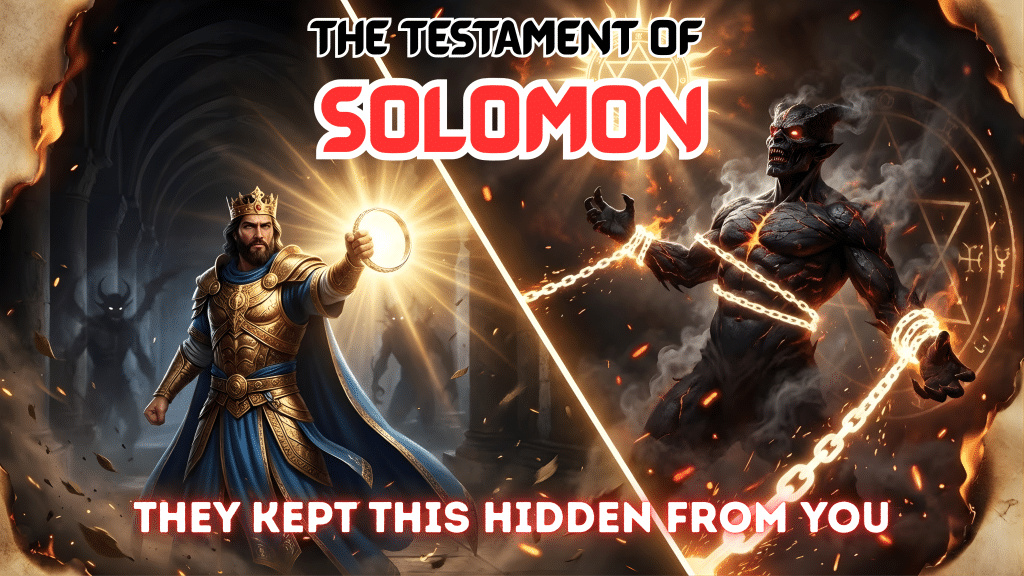
History remembers King Solomon for his divine wisdom. But a shadow text, a book so feared it was banished from scripture, reveals his true power—a ring to command demons. Was this a testament of faith, or the most dangerous grimoire ever written, a secret the church tried to bury forever?
The Echoes of a Forbidden Text
Beyond the hallowed halls of accepted scripture, in the shadowy corners of history, there are whispers of stories that refuse to be silenced. Among these is a text so strange and controversial it has been called everything from heretical fantasy to a dangerous manual of forbidden knowledge. It is a ghost in the library of faith, a book known as The Testament of Solomon.
For centuries, it existed on the periphery, a name muttered by mystics and scholars but almost entirely unknown to the world. It is not found in the Bible, the Torah, or the Quran. So why was it cast out? What was so threatening about this ancient document that it had to be buried, its very existence denied by the institutions that shaped Western civilization? To understand, we must first look at the man at its center.
King Solomon. The name itself evokes images of unparalleled wisdom, legendary wealth, and divine favor. He was the great king of Israel, son of David, the man who spoke to God and was gifted with an understanding beyond all mortals. He is the builder of the First Temple in Jerusalem, a monument of staggering beauty and a testament to his piety. This is the Solomon of history, the Solomon of scripture. But another Solomon lurks within the pages of this forbidden text—a master of arts far more arcane.
Imagine a story where Solomon’s great temple was not built by human hands alone. The Testament of Solomon claims just that. This narrative, a first-person account allegedly by the king himself, survived in scattered manuscripts, copied by scribes in Greek, Syriac, and Arabic, passed down through the centuries in secret. It wasn’t until the 17th century that a more complete Greek manuscript was brought to the attention of Western scholars, forcing them to confront a version of Solomon they had never imagined. This wasn’t just a lost story; it was a challenge to the very foundation of his legacy.
The text makes an astonishing claim: that King Solomon’s power was derived not only from God, but from a magical ring that gave him dominion over the spirit world. It asserts he could summon, interrogate, and command the very princes of Hell. He bound demons to his will, forcing them to reveal their secrets, to surrender their power, to become his slaves in the construction of God’s own Temple. It’s a breathtaking, terrifying proposition. The wisest man who ever lived, not just as a king, but as a sorcerer.
This document transforms a king into an occult master, a holy man into a wielder of demonic force. It presents a power so absolute it could build a holy sanctuary… or tear the world apart. To understand why this book was condemned to the shadows, we must first confront the secrets it claims to hold. What exactly did these bound spirits tell the king, and what terrifying price was paid for their knowledge?
Decoding the Author’s Intent
The first and most critical clue to understanding the Testament of Solomon lies not within its pages, but in its very name. To believe King Solomon himself penned this text is to miss the point entirely. We are entering the shadowy world of pseudepigrapha. The term literally means “writings with a false superscription,” a common literary device in the ancient world.
If you had written a revolutionary text but were an unknown scholar, how would you ensure it was read and respected? You would attribute it to a legendary figure. For a work concerning wisdom, magic, and commanding spirits, there was no greater name to invoke than Solomon. It was a deliberate choice, designed to grant the text an immediate and almost divine authority.
But is the Testament a complete fabrication, or could a kernel of genuine Solomonic tradition be buried within? The scholarly consensus is a resounding no. The fingerprints left on this document—its language, theology, and worldview—all point to a much later hand. The text is written in Koine Greek, the common language of the Mediterranean in the centuries after Christ, not the ancient Hebrew of Solomon’s court. It speaks of concepts and incorporates Hellenistic astrological ideas that were entirely foreign to 10th-century BCE Jerusalem. The voice we hear is not that of an ancient Israelite king, but of someone living in a world profoundly changed by Greek philosophy and Roman power.
This linguistic and cultural evidence allows us to narrow down its creation to the turbulent, multicultural landscape of the Roman Empire, likely somewhere between the first and fifth centuries AD. The most probable location of origin is Hellenistic Egypt or Roman-era Palestine, a crossroads where Jewish mysticism, Greek magical traditions, Babylonian demonology, and fledgling Christian thought collided and fused in fascinating new ways.
This only deepens the central mystery: why was it written? Was it a theological exercise to explain the problem of evil by cataloging its agents? Or was its purpose far more practical and dangerous—a grimoire disguised as a pious testament? A handbook for exorcists and magicians, offering the keys to command the very forces of darkness.
The text seems to serve both masters. It provides a theological framework for demons, but it also gives their names, their powers, and the exact methods to control them. This suggests it was created for a very specific audience: not the public, but perhaps a select group of mystics, healers, or exorcists. For them, this text wasn’t just a story. It was a shield and a sword. The author’s intent was to create a unified field theory of the supernatural, blending faith with forbidden knowledge. But to truly grasp its revolutionary ideas, we must confront the beings he cataloged with such terrifying precision.
The Grimoire’s Dark Allure
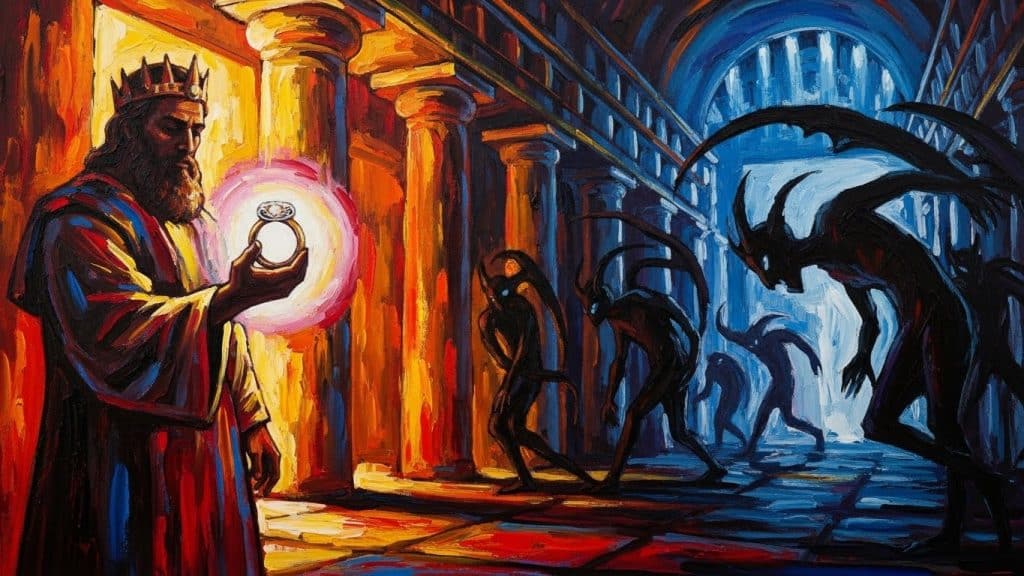
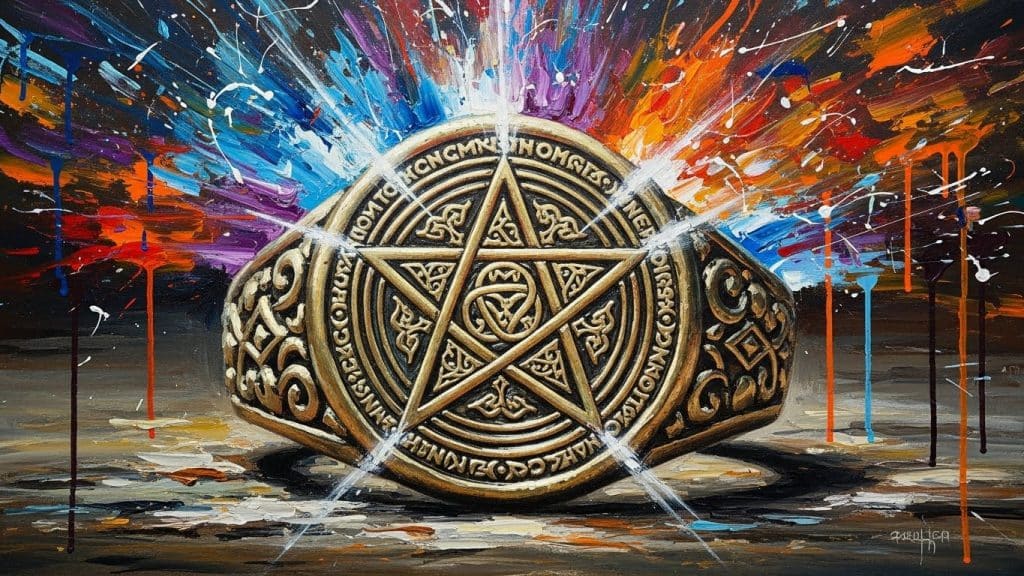
It arrived not in thunder or fire, but as a quiet solution to an impossible problem. An answer to a king’s desperate prayer, delivered by the Archangel Michael himself. A small ring, bearing an engraved seal. The text describes it as a pentalpha, a five-pointed star, a symbol of power that would echo through millennia as the Seal of Solomon. This wasn’t a shield for protection. It was a key—a tool for absolute dominion over the unseen world.
Armed with this celestial artifact, Solomon doesn’t just banish the demons plaguing his people; he begins a systematic interrogation. The Testament of Solomon reads like a field guide to the infernal, a chillingly precise catalog of darkness. He confronts Ornias, a shapeshifting entity that preys on men in their sleep. He faces Beelzeboul, the prince of demons, who claims to be the last of the fallen angels. He interrogates Asmodeus, the infamous spirit of lust and rage, who seeks to destroy the bonds of marriage. Each demon is compelled by the ring to confess its name, its malevolent purpose, and, crucially, the specific heavenly angel who holds power over it. It’s a veritable demonology 101 for an ancient king.
But what Solomon does next is what elevates this text from a simple story into a dangerous grimoire. He doesn’t perform a traditional exorcism. He doesn’t cast these entities out. He *binds* them. He enslaves them. This is not an act of faith; it is an act of force—a radical shift from religious supplication to magical coercion.
And what does a king do with an army of enslaved supernatural beings? He builds an empire. According to the Testament, Solomon puts these terrifying spirits to work constructing the most sacred site in ancient Judaism: the First Temple of God. The manuscript describes a breathtakingly blasphemous scene. Demons who once reveled in destruction are now commanded to hew stones from the quarry. Asmodeus, the bringer of chaos, is forced to braid ropes for the construction. The text claims God’s holy house was built, in part, by the very hands of his greatest adversaries.
This is the grimoire’s dark allure: the ultimate forbidden knowledge, the promise that one can harness chaos itself, bending the forces of hell to serve the ambitions of man. It paints Solomon not just as a wise king, but as the world’s first and most powerful magician. But wielding such power carries an immense risk. The line between controller and controlled can become terrifyingly thin. For the Testament reveals that even with the power of heaven on his finger, Solomon’s greatest weakness was not a demon he could command, but a desire hidden deep within his own human heart.
A Journey Through Ancient Manuscripts
The tales of Solomon, the demon-binder, are not just whispers on the wind; they are ink on parchment. Words copied by hand, passed down through centuries of secrecy and peril, forming a chain of evidence we can follow today. Our hunt for the Testament of Solomon begins not in the ancient sands of Judea, but in the hushed, climate-controlled archives of Europe, with threads stretching from Byzantine monasteries to the great libraries of Paris, London, and Vienna.
In the Bibliothèque Nationale de France, preserved under the designation ‘Parisinus Graecus 2419’, lies one of the most important 15th-century copies. Across the channel at the British Library, the Harleian manuscript 5596, a slightly later text, offers its own unique version. Each manuscript is a breadcrumb on a cold trail, revealing a startling truth: the Testament didn’t survive as a single, pristine book. It survived as a fugitive idea, copied and altered in the shadows.
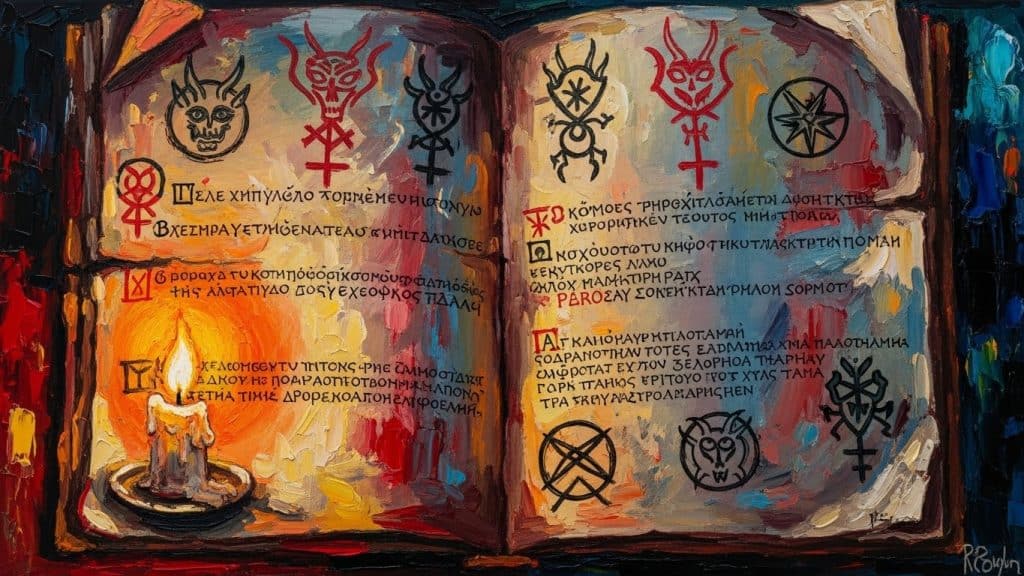
Finding these documents is only the first challenge. Unlocking their secrets is a philological minefield. No two major manuscripts of the Testament are exactly alike. The Greek text is notoriously difficult, riddled with what scholars call ‘corruptions’ – the inevitable errors and intentional changes made by generations of scribes. Demon names are spelled differently. Their powers shift. Entire passages exist in one manuscript but are absent in another. Translating the Testament is less like reading a book and more like textual archaeology.
This raises a tantalizing question about the scribes who dared to copy this text. Were they heretics, scholars, or monks fascinated by forbidden lore? In an age of strict religious orthodoxy, possessing, let alone meticulously copying, a how-to guide on commanding the legions of Hell could be a death sentence. Their motivations are lost to history, but their work remains.
These manuscripts are tangible links to their world. We can almost feel the texture of the vellum and see where the ink has faded. But this physical evidence also hints at what we’ve lost. Inconsistencies and abrupt endings suggest that what we have today might be incomplete. Are there lost chapters, detailing even more infernal encounters? Is there an undiscovered, more complete version lying forgotten somewhere?
The fragments we possess are more than just stories. They contain lists, sigils, and instructions. They were seen as functional and dangerous. As scholars pieced together these fragmented texts in the 19th and 20th centuries, they uncovered that the Testament of Solomon wasn’t just folklore. It was a blueprint.
Religious Condemnation and Suppression
As knowledge of this strange testament spread, it collided with the monolithic forces of organized religion. For the fledgling Christian Church, struggling to forge a unified doctrine, the Testament of Solomon was not just an oddity; it was a threat. Early Church Fathers, like the 3rd-century theologian Origen, condemned such works, warning against their “magical arts” and “demonic invocations.” They saw a text that blurred the sacred and the profane, treating demons not as enemies to be vanquished, but as a workforce to be managed. This wasn’t the wise king from their scriptures; this was a sorcerer. The condemnation was swift and absolute. The book was branded as apocryphal, a dangerous falsehood to be cast out.
This rejection wasn’t unique to Christianity. Within Jewish tradition, King Solomon’s authority is derived directly from God. While mystical traditions like Kabbalah explore the unseen, they do so through a framework of divine law. The Testament’s version of Solomon—a master of sigils and rings—was a stark and unsettling departure. It presented a power that could be *seized* through knowledge and ritual, rather than one granted through divine favor. Was this true wisdom, or the ultimate act of hubris?
This pattern of suppression was later institutionalized. In 1559, the Vatican established the Index Librorum Prohibitorum—the Index of Forbidden Books. While the Testament predates the Index, it is a perfect example of the kind of book it was designed to eliminate. If a man, even a king, could command the forces of both heaven and hell through a magical ring, what did that say about the established order? It suggested a universe run not on prayer and piety, but on esoteric formulas and cosmic loopholes, a direct challenge to theological authority.
The consequences for challenging that authority were very real. To be found with such a text was not a matter of literary curiosity but evidence of heresy. It could lead to social ostracization, excommunication, or worse. The owner became a pariah, suspected of trafficking with the very demons described in its pages. The book became a symbol of societal fear, a physical manifestation of a hidden, darker reality that the Church and state worked tirelessly to keep buried. But suppression often creates an equal and opposite reaction, begging the question: if the most powerful religious institutions wanted this text erased, how did any copy manage to survive?
Solomon’s Magic in Folklore and Legend
The story of Solomon, the master magician, could not be contained within the fragile pages of a single manuscript. It seeped out, bleeding into the folklore and imagination of cultures far and wide. While the holy books spoke of Solomon’s wisdom, a parallel narrative took shape in the shadows—a narrative of a sorcerer-king who commanded the very forces of darkness.
This alternate vision found fertile ground in the traditions of the Middle East. In the Qur’an, Solomon, or Sulaiman, is a prophet granted dominion over the winds, animals, and supernatural beings known as the Jinn. The parallels to the Testament are undeniable. Once again, Solomon harnesses otherworldly labor to construct his magnificent Temple. The demons of the Testament and the Jinn of Islamic lore are two sides of the same coin—powerful spirits bound to the will of a divinely-empowered mortal. The story had crossed religious and cultural boundaries, proving its viral power.
As centuries passed, this legend migrated into the heart of Europe, becoming a cornerstone for a new genre of dark literature: the medieval grimoire. Infamous books like The Key of Solomon and the Ars Goetia owe a profound debt to the Testament. They are, in essence, its descendants—practical field guides to demonology. They expand on the Testament’s core idea: that demons can be cataloged, their sigils identified, and through correct rituals, summoned and controlled. The Testament had become a blueprint for ceremonial magic.
Even today, the echo of Solomon’s power persists, woven into our modern mythology. Think of any story where a hero uses a magical seal or a true name to command a powerful entity. The DNA of that idea can be traced back to Solomon. From fantasy novels where wizards bind elementals to video games where players summon creatures using intricate symbols, his legacy is everywhere. He is the archetype of the wise magician who walks the razor’s edge between order and chaos.
The legend of Solomon the magician became a cornerstone of occult traditions, a blueprint for power. But this very influence cast a dark shadow over the Testament itself, transforming it from a curious piece of folklore into something dangerous and heretical. But why did the religious authorities of the world find this ancient demonology so terrifying, and why did they feel they had to ensure its secrets were buried forever?
The Mystery of the Fallen Angels and the Watchers
The Demons Within: Psychological Interpretations
For centuries, we have read the Testament of Solomon as a chronicle of the supernatural. But what if the demons were never external entities at all? What if the true horror, and the ultimate power, of this forbidden text lies not in hell, but within the landscape of the human mind?
Viewed through a modern psychological lens, the Testament transforms. It is no longer a grimoire of magic, but a sophisticated manual for mastering the self. Each demon Solomon confronts ceases to be a literal monster and becomes a powerful allegory. Asmodeus, the king of demons, is the personification of unchecked lust and destructive rage. Ornias, the vampiric spirit, becomes the embodiment of distraction and the insidious theft of our vital energy. Suddenly, these are not ancient spirits, but timeless struggles we all recognize: the demons of addiction, envy, despair, and pride.
Solomon’s epic struggle to build the Temple, then, is not just a construction project. It’s an internal war. His ring, the seal of God, is not a magical artifact, but a symbol of disciplined will and higher consciousness. When he binds a demon, he is engaging in a profound act of self-confrontation. He is forcing a destructive impulse into the light, identifying it, and putting its chaotic energy to constructive use. The battle for the Temple becomes the battle for the self.
The famed psychoanalyst Carl Jung might have called these demons archetypes of the “shadow”—the dark, repressed, and unwanted parts of our own personality. Jung argued that we cannot destroy our shadow; we must integrate it, understand its nature, and harness its power to become whole. This is precisely what Solomon does. He doesn’t annihilate the demons; he interrogates them, learns their secrets, and puts them to work. He turns his greatest internal liabilities into his most powerful assets.
Looked at this way, the Testament offers a startlingly modern therapeutic framework. The first step in conquering any personal struggle is to name it, to define it, to understand how it works. Solomon’s relentless interrogation of each spirit—’Who are you? By what star are you thwarted?’—is a blueprint for cognitive behavioral therapy. The act of naming the demon is the act of robbing it of its amorphous, terrifying power.
This banned book, dismissed as occult fantasy, may in fact be one of the earliest guides to psychological self-mastery ever written. It suggests that our greatest demons are not summoned from some fiery pit, but are born within us. And, more importantly, it offers a path to becoming their master. But if the Testament is such a sophisticated map of the human psyche, it raises a deeply unsettling question: who could possibly have written it two thousand years ago?
Science vs. Superstition: A Historical Clash
For centuries, the world described in the Testament of Solomon was not an allegory. It was a terrifying reality. Demons were the explanation for plague, madness, and failed crops. The universe was a battleground, and humanity was caught in the middle. But a slow, seismic shift began with the dawn of rationalism. The lens of the telescope replaced the scryer’s mirror, and the anatomist’s chart challenged the demonologist’s bestiary. The world of invisible spirits was about to collide with the uncompromising force of human reason.
The first front in this war was the human body. Afflictions once blamed on Asmodeus or Beelzeboul were viewed through a new, medical lens. The demon causing violent fits was given a new name: epilepsy. The spirit of madness was re-diagnosed as melancholia, an early precursor to our understanding of depression. Even the demon Ornias, said to cause physical wasting, could be seen as an ancient attempt to explain devastating illnesses like tuberculosis or cancer. The exorcist was slowly being replaced by the physician.
This intellectual movement reached its zenith in the Age of Enlightenment. Thinkers across Europe championed reason as the highest virtue. Ancient texts, once revered as unassailable truth, were now subjected to intense scrutiny. For these new philosophers, a grimoire like the Testament of Solomon was a historical artifact, a fascinating but flawed window into a more credulous age. They asked for empirical data. Where were these demons? Could they be summoned in a controlled setting? The silence in response was deafening. The book’s power was shifting from the literal to the literary.
Today, the scientific consensus is firm. The phenomena described in the Testament belong to the realm of mythology, not physics. The demons are understood not as objective entities, but as powerful personifications of human fear, illness, and psychological turmoil. Science offered a new map of reality, and on that map, there were no regions marked “Here be demons.”
And yet, the story is not that simple. For all our modern understanding, billions of people still hold a profound belief in a spiritual world. Exorcisms are still performed by established churches. The ancient anxieties that gave birth to the Testament’s demons—fear of sickness, of chaos, of the darkness inside ourselves—have not disappeared. Science provided answers, but for many, it did not provide comfort. If these entities are not external forces, but symbols of the darkness lurking within the human mind, are they any less real, or any less dangerous?
The Power of the Word: Incantations and Amulets
The signet ring was the key, but a key is useless without knowing which words turn the lock. The true power Solomon wielded was in the words he spoke. The Testament of Solomon is, at its core, a manual of verbal command. When confronting each spirit, the king performs a precise verbal exorcism, invoking the specific name of the angel who holds dominion over that demon and pronouncing the sacred names of God. This is linguistic magic in its purest form.
The text reads like a supernatural field guide: to control the demon of headaches, you must invoke the name of the archangel Michael. This reveals a profound ancient belief: language is a weapon. For these cultures, words contained the very essence of things. To know something’s true name was to have absolute power over it. Speaking was an act of creation, and a precisely uttered phrase could bind a spirit as surely as any iron chain. This power was inscribed on objects like amulets and talismans, turning them into portable shields in an unseen war.
This practice was not unique. The great magical traditions of Egypt and Babylon were built on it. The famous Greek Magical Papyri, a collection of spells from Greco-Roman Egypt, mix Greek, Egyptian, Coptic, and Hebrew words, believing power was amplified by combining names from multiple pantheons.
This forces us to ask about the nature of Solomon’s magic. The ancients distinguished between Theurgy and Goetia. Theurgy is “high magic,” working with gods and angels through prayer. Goetia is “low magic,” the art of compelling and commanding demons. Where does the Testament fit? It exists in a fascinating, dangerous grey area. Solomon uses the authority of God and the names of His angels (Theurgy), but his purpose is to enslave demons to build a physical temple (a Goetic act). He uses the tools of heaven to practice a magic many would consider infernal, a fusion of the sacred and the profane that may explain why the text was suppressed. But in any negotiation with darkness, there is always the risk of deception. What if the very incantations Solomon relied on contained a hidden flaw?
The Ethical Dilemma of Ancient Magic
With a divine seal and a litany of celestial names, Solomon had done the impossible. He hadn’t just defeated the demons; he had enslaved them. But this unprecedented power forces us to confront an uncomfortable ethical question. Humanity’s relationship with the divine was almost always one of supplication. The Testament of Solomon proposes a radical alternative: not asking, but *commanding*. Is it morally right to compel a being, even a malevolent one, to do your bidding? Or does this act of coercion fundamentally corrupt the user, turning them into a tyrant of the unseen world?
The text itself seems to wrestle with this dilemma. Woven into its fantastic catalogue are warnings that this power cuts both ways. The narrative hints that forcing demons to perform labor, even for a holy purpose, is a spiritually dangerous transaction. The very act of mastering these entities seems to come at a cost, a slow spiritual poisoning the user might not recognize until it is too late.
The Testament doesn’t always paint its demons in broad, evil strokes. Some are presented as spirits of specific ailments or natural phenomena. Does forcing a “demon of fever” to depart from a sick child make the act righteous, or is it still a violation of a cosmic order? The text provides no easy answers. It presents a world of cosmic grey, where power is a neutral force, and its morality is determined entirely by the one who wields it.
This is perhaps the Testament’s most profound legacy. It strips away the comfort of divine law and places the entire burden of ethical choice onto the individual. Imagine holding that ring. The power to build, heal, and know secrets… but also the power to destroy, manipulate, and enslave. The only thing stopping you is your own conscience. For many modern practitioners of ceremonial magic, the Testament is a foundational yet controversial work. They know the story’s ending. Solomon’s tale does not end in triumph; it ends in a catastrophic fall from grace, a warning that the ultimate price for this forbidden knowledge was not paid by the demons, but by Solomon himself.
Architectural Echoes: The Temple’s Secrets
With a ring to command the legions of the spirit world, Solomon possessed immense power. To what end? The Testament is explicit: this was about building a house for God himself—the First Temple of Jerusalem. Historical accounts in the Hebrew Bible describe a monumental structure of cedar, cypress, and gold, taking seven years to complete, an unprecedented feat of engineering for the 10th century BCE. It was the dwelling place of the Ark of the Covenant, the center of the spiritual world.
But the Testament of Solomon reveals a foundation built on the impossible. It claims the temple’s most arduous tasks—quarrying colossal stones, raising massive pillars—were carried out by the very demons Solomon had bound to his will. Imagine legions of infernal spirits, their immense power harnessed in service of the divine.
It’s an outrageous claim, yet it offers a fantastical answer to a real question: how did ancient civilizations achieve such architectural marvels? From the pyramids to the temples of South America, we find structures that seem to defy the limits of pre-industrial labor. Attributing these feats to gods, giants, or subjugated demons was a way for the ancient mind to make sense of the seemingly miraculous.
Perhaps we should read this not as a construction manual, but as a profound allegory. Could the demons represent the chaotic, untamed forces of the world? Solomon, the wise king, isn’t just building a temple of stone; he is building a temple of order and divine will. He tames the chaos of pagan nations and his own inner demons, channeling all this conquered energy into a singular, holy purpose. The demon laborers become a powerful metaphor for the triumph of wisdom over primordial darkness.
This interpretation runs into a hard wall of silence. We have detailed biblical accounts of the temple’s construction, listing artisans and human laborers. Yet there is not a single word about demonic assistance. Archaeologists have found no blueprints signed by Beelzebub. The gap between the Testament’s story and recorded history is a chasm. So why tell this story? The answer may lie not in what the demons built, but in what else Solomon commanded them to do.
The Testament and Other Apocryphal Works
To truly understand the Testament of Solomon, we must see it not as an isolated work, but as a single voice in a vast, hidden choir. For centuries, a shadow library of sacred texts flourished alongside the books that would eventually form the Bible. These are the Apocrypha and the Pseudepigrapha—the “hidden things” and the “falsely ascribed” writings.
Consider the famous Book of Enoch, with its detailed accounts of fallen angels, or the Gospel of Thomas, a collection of secret sayings of Jesus. When you place the Testament beside these, a pattern emerges: a shared obsession with cosmic secrets and humanity’s power to command forces beyond its comprehension. The ancient world was awash in stories of angels, demons, and forbidden knowledge. These weren’t fringe ideas; they were part of a vibrant spiritual conversation.
This thriving literature posed a serious problem for the early church fathers. As they worked to forge a unified faith, they needed a single, authoritative source—a canon. The process was a centuries-long debate. Books were judged on their supposed apostolic origin, theological consistency, and acceptance by the wider church.
The Council of Laodicea in the 4th century, for example, produced one of the earliest lists of canonical books, explicitly excluding apocryphal works from being read in church. Texts like the Testament of Solomon, with its elaborate demonology and overt magical practices, were simply too wild, too esoteric, and too far removed from the emerging orthodox narrative. They were deemed dangerous, heretical, or inauthentic. And so, they were cast out, banned.
This raises a haunting question. The texts that were excluded are merely the ones we know about. What about the ones that didn’t survive? How many other “Testaments,” gospels, and magical treatises have vanished forever? The accepted canon is not just a collection of books that got in; it’s a monument built on top of countless stories that were silenced. This leads us to the ultimate gatekeepers who drew the line in the sand. What were they so afraid of the world discovering?
Modern Rediscoveries and Renewed Interest
For centuries, it languished in the shadows—a ghost story whispered among scholars. The Testament of Solomon, once suppressed and nearly forgotten, was a secret buried by history. But no text stays buried forever. Its resurrection began in the quiet halls of 19th-century academia with the emergence of the textual scholar. These academics treated ancient, banned scriptures not as heresy, but as historical evidence.
A crucial moment came in 1898, when scholar F.C. Conybeare published the first major English translation, finally exposing the full, bizarre narrative to a modern, English-speaking audience. The seal was broken. What followed was a cascade of accessibility. Translations into modern languages moved the text from locked university archives into the hands of a curious public. This wasn’t just translation; it was the democratization of forbidden knowledge.
Then came the digital age. Online archives and academic databases accomplished in years what had once taken lifetimes. Fragile manuscripts, separated by thousands of miles, were now digitized, collated, and available to anyone with an internet connection. A researcher in Tokyo could now compare a passage from a manuscript in Paris with one in the Vatican with a few clicks. The gatekeepers of information were becoming obsolete.
This new accessibility coincided with a powerful cultural shift: a widespread revival of interest in the occult and esoteric traditions. For a new generation of seekers, the Testament became more than a historical curiosity. Its detailed lists of demons and methods for binding them made it a practical handbook, a grimoire pulsing with forgotten power. The internet became the crucible for this renewed interest, with online forums and social media groups creating global communities dedicated to deciphering its secrets. The whispers from the margins of history had suddenly become a worldwide conversation.
The book is now more accessible than at any point in its two-thousand-year history. But with this unprecedented access comes a crucial question. Is the Testament of Solomon merely a fascinating relic, or have we, in our modern curiosity, finally unlocked a door that the ancients knew was better left sealed?
The Quest for Solomon’s Ring
At the very heart of the *Testament of Solomon* is an object of impossible power: a single ring, given to the king by the Archangel Michael. According to the text, it was made of a divine alloy, set with a stone engraved with the Pentalpha—the five-pointed star. Its function was absolute: to grant Solomon complete dominion over the demonic world. With it, he could bind and compel any entity, from the lowest imp to the most terrifying princes of Hell. Imagine a single device that could enslave an invisible workforce to build one of the ancient world’s greatest wonders.
For centuries, the quest for Solomon’s Ring haunted the dreams of mystics, alchemists, and kings. Historical records and occult manuscripts are filled with whispers of those who sought it—from the medieval Knights Templar to the Elizabethan magus John Dee. The ring represented the ultimate shortcut to knowledge and power, a prize worth any price.
But was the ring ever a physical object, or is that a misunderstanding of the text? Many scholars argue the *Testament* is an allegory. In this reading, the ring is a powerful symbol for something internal: divine wisdom. It represents the enlightened human will, capable of mastering the chaotic “demons” of our own base instincts. To possess the ring is not to find an artifact, but to achieve perfect self-control.
And yet, the image of the physical ring endures, its power echoing into our own time. We see its reflection in fantasy literature, in the one ring to rule them all. But the *Testament of Solomon* is, above all, a cautionary tale. It warns that such power is a poison chalice. The very instrument that allowed Solomon to build God’s Temple is what led to his downfall, as his hubris and desires ultimately corrupted him. The story is a timeless meditation on a terrifying truth: the quest for absolute power inevitably leads to absolute corruption.
According to legend, Solomon, in his final days, threw the ring into the sea, believing its influence too dangerous for the world. But power like that rarely disappears so easily. If the legends are true, what became of the cosmic entities it once controlled, and what ancient knowledge did they leave buried beneath the Temple’s foundation?
The Unanswered Questions and Enduring Legacy
After a journey through whispered histories and condemned manuscripts, we arrive at a precipice of unanswered questions. Who truly penned the Testament of Solomon? Was it a pious scholar or a practicing magician? Was its purpose literal instruction, a moral allegory, or something far stranger? The text itself offers no easy answers. This ambiguity has created a battleground of interpretation that rages to this day. The consensus remains elusive because the Testament is a layered document, a palimpsest of beliefs written over by different hands in different eras.
Yet, while scholars debate its origins, its legacy is undeniable. Its hierarchical structure of the demonic realm and methods of binding them became a blueprint for much of Western ceremonial magic, from the famed medieval *Key of Solomon* to the notorious *Ars Goetia*. Its DNA is woven into the very fabric of Western esotericism.
Why does a book like this continue to hold such power over the human imagination? Perhaps because of the profound allure of the forbidden. The act of banning a text doesn’t destroy its ideas; it infuses them with a dangerous mystique. But deeper, we find something far more relatable. The demons are the spirits of disease, envy, discord, and madness—the personification of every timeless anxiety that plagues humanity. In Solomon’s quest to identify, confront, and bind these forces, we see a reflection of our own struggle for control in a chaotic world.
Ultimately, to label the Testament of Solomon as merely “banned” or “heretical” is to miss its importance. Texts like these are not just catalogs of superstition; they are cultural artifacts of the human psyche. They reveal what we once feared, what we desired, and the extraordinary lengths we would go to in order to make sense of our place in the cosmos. To study them is to recognize that the impulse to explore the darkness, to chart the unseen world and bend it to our will, is one of the oldest and most enduring stories we have ever told.
The official story has been told, but what about the texts they banished? The choice to seek the forbidden is now yours. Don’t just accept history—question it. Uncover the pages they tried to erase and decide for yourself what secrets have been kept in the shadows.
Frequently Asked Questions
What is the Testament of Solomon?
The Testament of Solomon is an ancient apocryphal text, not included in the biblical canon. It is written from the first-person perspective of King Solomon and details how he was given a magical ring by the Archangel Michael, which he used to control, interrogate, and enslave demons to build his Temple in Jerusalem.
Why is the Testament of Solomon not in the Bible?
The Testament of Solomon was excluded from the biblical canon for several reasons. It was written centuries after King Solomon’s time, in Greek, not Hebrew. Its content, focusing on magic, demonology, and commanding spirits, was considered heretical and inconsistent with the theological doctrines being established by early Church Fathers.
Did King Solomon really command demons with a magic ring?
There is no historical or archaeological evidence to support the claim that King Solomon commanded demons. Scholars view the Testament of Solomon as a work of pseudepigrapha (falsely attributed writing) and a piece of religious folklore or allegory, rather than a historical account. The story reflects ancient beliefs about magic and the supernatural.
What is the Seal of Solomon?
In the Testament of Solomon, the Seal of Solomon is an engraving on the magical ring given to him. The text describes it as a ‘pentalpha,’ which is a five-pointed star (pentagram). This symbol was believed to hold the power to control spirits and has become a central icon in Western occultism and ceremonial magic.
Is the Testament of Solomon a grimoire?
Yes, the Testament of Solomon is considered one of the earliest examples of a grimoire, which is a textbook of magic. It provides a detailed catalog of demons, their names, their powers, the angels who can thwart them, and the methods (using the ring and incantations) to command them, fitting the definition of a practical guide to magic.