
Table of Contents
In the annals of biblical history, few moments carry the visceral weight and spiritual intensity of the confrontation on Mount Carmel. It is a scene of stark contrast: one man standing against four hundred and fifty prophets of a false god; the silence of a three-year drought against the roar of a desperate crowd; and the simplicity of truth against the theatrics of deception. At the center of this narrative stands the Prayer of Elijah—a brief, sixty-three-word invocation (in the English translation) that altered the course of a nation and summoned fire from heaven.
Many believers today mistake length for depth, assuming that effective prayer requires hours of repetition or eloquent vocabulary. However, the Prayer of Elijah recorded in 1 Kings 18 demonstrates that heaven does not respond to our verbosity, but to our veracity. It is a masterclass in covenantal alignment, spiritual authority, and total dependence on God. By dissecting this powerful prayer, we can uncover the spiritual mechanics that release God’s power into our own impossible situations.
The Historical Context: A Nation in Apostasy
To fully grasp the magnitude of the Prayer of Elijah, we must first understand the darkness that surrounded it. Israel was under the rule of King Ahab, a man described as having done “more evil in the eyes of the Lord than any of those before him” (1 Kings 16:30). His marriage to Jezebel, a Sidonian princess, had imported the worship of Baal—a storm and fertility god—into the heart of Israel. Yahweh’s altars were torn down, His prophets were hunted, and the people were limping between two opinions.
Elijah had previously declared a drought, stating that neither dew nor rain would fall except at his word. This was a direct theological assault on Baal, who was believed to control the rain. For three and a half years, the heavens were brass. The land was parched, illustrating the spiritual dryness of the people. The Prayer of Elijah was not just a request for a miracle; it was a judicial proceeding to determine who was the true God of Israel.
The Showdown on Mount Carmel
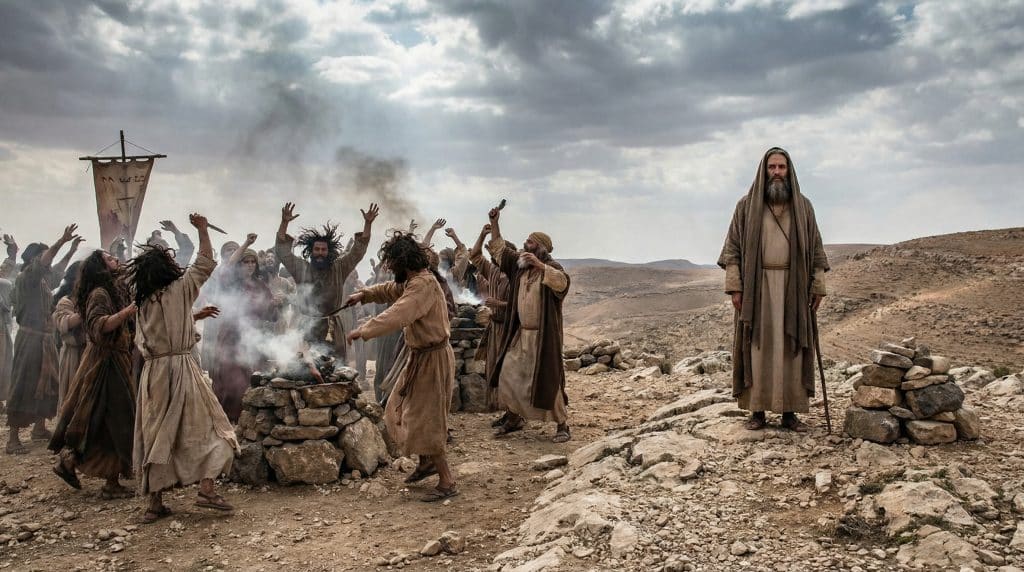
The confrontation took place on Mount Carmel, a geographical promontory that jutted out towards the sea—traditionally a place lush with vegetation, now withered by judgment. The stakes could not have been higher. If Elijah failed, he would die, and Yahwism might have been extinguished from the public life of Israel.
The prophets of Baal went first. For hours, from morning until noon, they cried out, “O Baal, answer us!” They danced, shouted, and eventually cut themselves with swords and lances until blood gushed out. This scene is crucial because it highlights what the Prayer of Elijah was not. It was not manipulative. It was not frantic. It was not based on the effort of the flesh. The prophets of Baal believed they could twist their god’s arm through intensity and sacrifice. Elijah knew he didn’t need to twist God’s arm; he only needed to hold God’s hand.
Preparing the Altar: The Prerequisites of Power
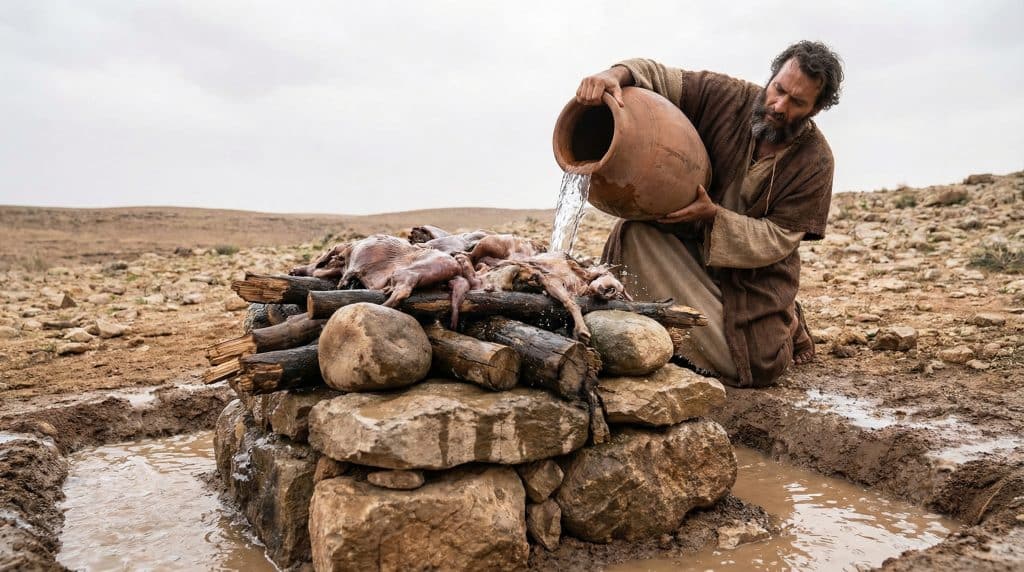
Before uttering the Prayer of Elijah, the prophet engaged in a specific set of actions that prepared the atmosphere for the miraculous. 1 Kings 18:30 tells us, “Then Elijah said to all the people, ‘Come near to me.’ So all the people came near to him. And he repaired the altar of the Lord that was broken down.”
You cannot pray the Prayer of Elijah while standing on the debris of a compromised altar. The repair was deliberate:
- The Twelve Stones: Elijah took twelve stones, representing the twelve tribes of the sons of Jacob. Despite the political division between the Northern Kingdom (Israel) and the Southern Kingdom (Judah), Elijah viewed them as one covenant people under God. He aligned his physical reality with God’s covenantal view.
- The Trench and Water: In a move that defied logic, Elijah dug a trench and ordered four large jars of water to be poured over the sacrifice—three times. Twelve jars of water in a drought. This removed any possibility of a trick. If fire was to fall, it had to be supernatural. This action declared, “I am making it impossible for man so that it is undeniably God.”
It was at the time of the evening sacrifice—a moment of synchronized worship prescribed in the Law of Moses—that Elijah stepped forward. He did not pray at a random time; he prayed in alignment with the rhythms of redemption.
Deconstructing the Prayer: Line by Line Analysis
The text of the Prayer of Elijah is found in 1 Kings 18:36-37. In the New King James Version, it reads:
“Lord God of Abraham, Isaac, and Israel, let it be known this day that You are God in Israel and I am Your servant, and that I have done all these things at Your word. Hear me, O Lord, hear me, that this people may know that You are the Lord God, and that You have turned their hearts back to You again.”
Let us break down this Prayer of Elijah to understand its potency.
1. “Lord God of Abraham, Isaac, and Israel…”
Elijah begins by invoking the Covenant. Note that he uses the name “Israel” instead of “Jacob.” This is significant. Jacob was the deceiver; Israel was the prince who had power with God. Elijah was reminding God (and the people) of their transformed identity and the ancient promises made to the patriarchs. He was anchoring his petition not in current circumstances, but in eternal covenants.
2. “…Let it be known this day that You are God in Israel…”
The primary motive of the Prayer of Elijah was the glory of God. It was not about Elijah’s reputation or the end of the drought for comfort’s sake. The issue was the vindication of God’s name. When our prayers shift from “God, give me this” to “God, glorify Your name through this,” we enter a higher realm of authority.
3. “…And I am Your servant, and that I have done all these things at Your word.”
This is the secret to the boldness of the Prayer of Elijah. Elijah was not acting on a whim. He wasn’t “naming and claiming” something he invented. He had received a word from God (likely in the secret place) and was now executing it in the public place. Boldness comes from obedience. Because Elijah knew he was submitting to God’s command, he had no doubt that God would back him up.
4. “Hear me, O Lord, hear me, that this people may know…”
The repetition of “Hear me” (answer me) shows earnestness, but the “so that” clause reveals the heart of the prophet. The goal of the fire was revival. The Prayer of Elijah was redemptive. He wanted the hearts of the people turned back. Miracles are never just for spectacle; they are signposts pointing wandering hearts back to the Father.
The Divine Response: Why Fire Fell
Verse 38 records the immediate answer: “Then the fire of the Lord fell and consumed the burnt sacrifice, and the wood and the stones and the dust, and it licked up the water that was in the trench.”
Notice the totality of the consumption. The fire did not just burn the meat; it burned the stones and the dust. This was a supernatural fire, likely similar to the fire that consumed the sacrifice at the dedication of the Tabernacle and Solomon’s Temple. It was the sign of God’s acceptance.
Why did the fire fall? It fell because the conditions were met. The Prayer of Elijah was the spark, but the sacrifice, the obedience, and the faith were the fuel. God answered by fire to demonstrate that He is the living God who consumes sin and accepts the substitute. In the New Testament context, we look to the Cross, where the fire of God’s judgment fell on Jesus so that we might receive the fire of the Holy Spirit.

Applying the Prayer of Elijah in Modern Life
How do we apply the principles of the Prayer of Elijah in our 21st-century lives? We may not be calling down literal fire on a mountain, but we face “prophets of Baal” in the form of cultural ideologies, personal addictions, and spiritual apathy. The book of James tells us, “Elijah was a man with a nature like ours, and he prayed earnestly… James 5:17. This means the power was not in Elijah’s genetics, but in his alignment.
1. Repair Your Altar
Before you pray for a breakthrough, check your altar. Is your life consecrated? Have you allowed the stones of your daily devotion to crumble? The Prayer of Elijah requires a foundation of repentance and dedication.
2. Prioritize God’s Glory
Check the motive of your prayers. Are you praying to be comfortable, or are you praying that God would be known in your workplace, your family, and your city? Prayers centered on God’s reputation carry immense weight in the courts of heaven.
3. Pray the Word
Elijah prayed, “I have done these things at Your word.” We should pray the Scriptures back to God. When we pray the Bible, we are praying the will of God. This eliminates doubt because we know God watches over His word to perform it.

Conclusion
The Prayer of Elijah stands as a timeless testament to the power of one individual fully surrendered to God. It teaches us that the majority is not always right and that the loudest voices do not always carry the most authority. In just sixty-three words, Elijah dismantled a demonic stronghold and restored a nation to the worship of Yahweh.
Today, God is looking for men and women who will repair the altars, refuse to bow to the idols of the age, and pray with the same covenantal boldness. He is looking for those who will pray not just for the relief of rain, but for the consuming fire of His presence. When you pray the Prayer of Elijah, you are inviting the Sovereign Lord to demonstrate His reality in a world that has forgotten His name.


Pingback: What Does the Bible Say About Forgiveness? A Complete Biblical Guide 2026 - Soft Bible