
Table of Contents
- Introduction to the Legend
- Biblical History vs. Apocryphal Myth
- The Testament of Solomon: The Ring’s Origin
- The Gift of Archangel Michael
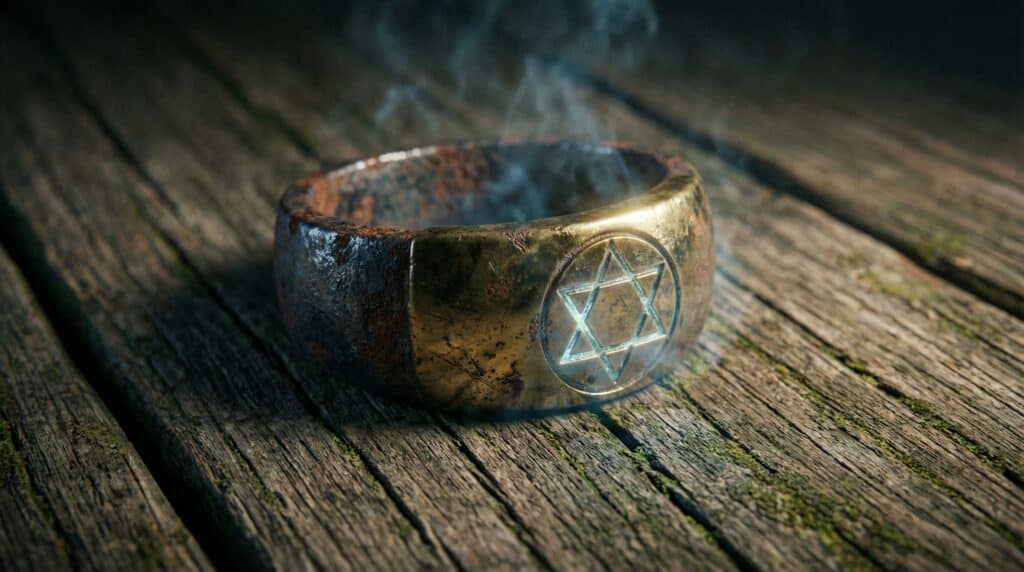
- Appearance and Composition: Brass and Iron
- Powers of King Solomon’s Ring
- Controlling the Infernal Hierarchy
- Symbolism: The Seal of Solomon
- The Ring in Islamic Tradition
- Legacy in Western Occultism
- Conclusion
- FAQs
Introduction to the Legend
In the annals of religious mythology and esoteric history, few artifacts possess the awe-inspiring reputation of King Solomon’s Ring. While the biblical King Solomon is renowned primarily for his wisdom and the construction of the First Temple in Jerusalem, legends that proliferated in the centuries following his death paint a different picture: that of a master magician who commanded the forces of nature and the spirit world. Central to this legendary status is the specific instrument of his power ring.
This artifact, often conflated with the Seal of Solomon, is said to have been a signet ring engraved with the name of God, granting the monarch absolute dominion over demons (jinn) and the ability to communicate with animals. From Jewish Talmudic traditions to Islamic accounts and Christian apocrypha, ring of solomon represents the ultimate intersection of divine authority and magical practice. But what are the origins of this tale? How did a king celebrated for his proverbs become the central figure of ceremonial magic? To understand the magnitude of this legend, we must delve deep into the texts that transformed a wise ruler into the master of the King Solomon’s Ring.
Biblical History vs. Apocryphal Myth
To truly grasp the significance of King’s Ring, one must distinguish between the canonical scriptures and the rich tapestry of folklore that surrounds them. In the canonical Hebrew Bible (specifically 1 Kings), Solomon is gifted wisdom by God in a dream. There is no explicit mention of ring serving as a magical talisman to bind spirits. The Bible focuses on his administrative acumen, his wealth, and his eventual downfall caused by foreign wives and idolatry.
However, the seeds of the legend regarding ring were sown by the first century. The Jewish historian Josephus, in his work Antiquities of the Jews, mentions that God granted Solomon knowledge of the art used against demons for the benefit of men. Josephus describes witnessing a fellow Jew named Eleazar using a ring that contained a root prescribed by Solomon to exorcise a demon from a possessed man in the presence of the Roman Emperor Vespasian. This early account suggests that by the first century CE, the concept of King Solomon’s Ring as a tool for exorcism and spiritual command was already well-established in the cultural consciousness.
The Testament of Solomon: The Ring’s Origin
The most detailed and authoritative source regarding King Solomon’s Ring is the Testament of Solomon. This pseudepigraphical text, likely written between the 1st and 5th centuries CE, serves as a grimoire a manual of magic framed as an autobiographical account by the King himself. It provides the definitive origin story of seal , moving it from vague folklore to a specific narrative event.
According to the text, the story begins during the construction of the Temple of Jerusalem. One of the master builder’s favorite workmen, a young boy, was suffering. A demon named Ornias was visiting the boy every evening, stealing his pay, and sucking the vitality from his thumb. When Solomon questioned the boy about his thinning frame, the boy revealed the demonic harassment. Moved by this plight, Solomon prayed fervently to the Lord for help. The answer to his prayer was the delivery of seal of solomon.
The Gift of Archangel Michael
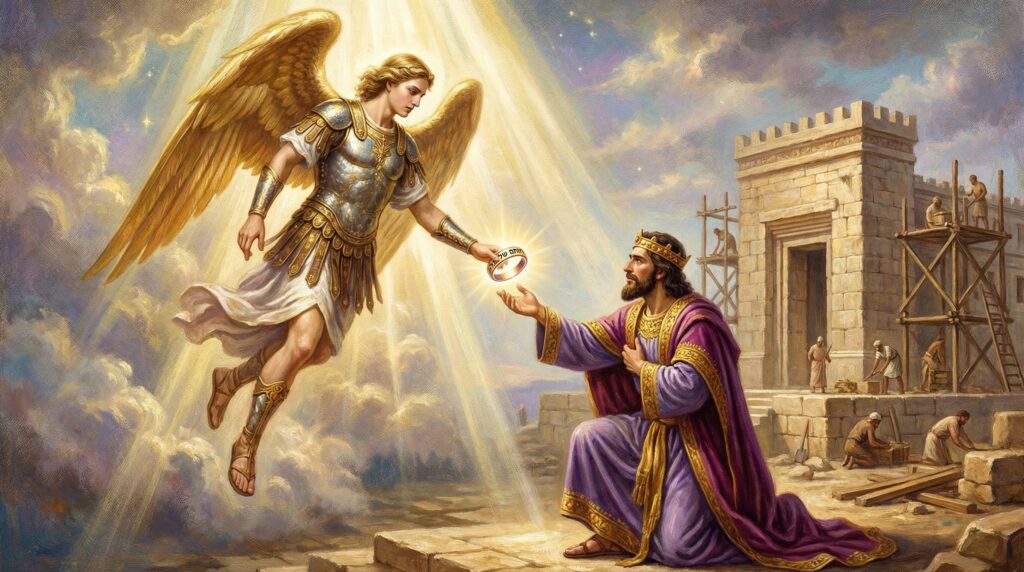
The Testament of Solomon describes the pivotal moment when ring entered the mortal realm. While Solomon was praying, the Archangel Michael appeared to him, bearing a small, shining object. Michael presented the artifact to the King, declaring: “Take, O Solomon, King, son of David, the gift which the Lord God has sent thee, the highest Sabaoth. With it thou shalt lock up all demons of the earth, male and female; and with their help thou shalt build up Jerusalem.”
This passage establishes the divine provenance of seal. It was not forged by human hands, nor was it a product of dark sorcery. It was a sanctioned tool of divine will, intended for a holy purpose: the construction of the Temple. The authority of King Solomon’s Ring was absolute because it carried the seal of the Living God. Upon receiving the ring, Solomon immediately tested its power by confronting Ornias, marking the beginning of his campaign to bind the infernal hierarchy using King Solomon’s Ring.
Appearance and Composition: Brass and Iron
What did King Solomon’s Ring actually look like? Descriptions vary across texts, but specific details in the esoteric tradition paint a vivid image. The ring is often described as being made of two distinct metals: brass and iron. This dual composition was functional, not merely aesthetic. In the logic of Solomonic magic, it utilized brass to command the good or neutral spirits (jinn) and iron to bind and compel the evil demons.
Furthermore, the ring featured a gem or a bezel engraved with a specific seal. This seal, known as the Pentalpha (five-pointed star) in the Testament and later evolved into the Hexagram (six-pointed star) in medieval tradition, contained the Ineffable Name of God (the Tetragrammaton). It was this engraving that gave King Solomon’s Ring its binding power. When the seal was pressed against a demon, or when the ring was shown to them, they were rendered powerless, forced to obey the wearer. The physical reality of King Solomon’s Ring was a microcosm of the universe combining earthly metals with divine geometry to bridge the gap between worlds.
Powers of King Solomon’s Ring
The primary function of King Solomon’s Ring was the enslavement of demons, but its powers extended far beyond simple coercion. The legends suggest that King Solomon’s Ring granted the wearer a form of omniscience regarding the natural and supernatural worlds.
First, King Solomon’s Ring allowed for communication with animals. In both Jewish and Islamic folklore, Solomon could understand the language of birds, beasts, and insects. This ability is famously highlighted in the Quranic account of the ant valley, where Solomon hears an ant warning its colony. Second, the ring provided protection. It acted as a spiritual shield; no demon could harm the King while he possessed King Solomon’s Ring. Third, it had the power to seal prisons. Solomon famously used King Solomon’s Ring to seal demons inside brass vessels (the origin of the genie in the lamp myth), casting them into the sea or deep pits to prevent them from troubling humanity.
Controlling the Infernal Hierarchy
The application of King Solomon’s Ring in the Testament of Solomon is methodical. Solomon uses the ring to summon demons one by one, interrogate them, and then bind them to labor. He demands to know their names, their associated zodiac signs, the diseases they cause, and the angels that have power over them. This interrogation aspect makes King Solomon’s Ring a tool of scientific inquiry into the spirit world.
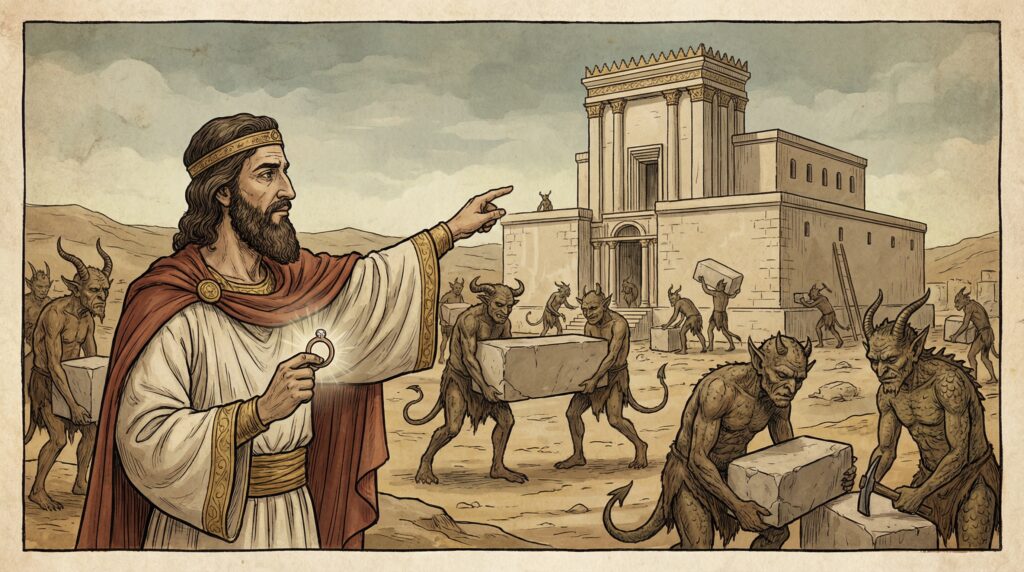
For example, Solomon uses King’s Ring to bind Asmodeus, the prince of demons. Despite Asmodeus’s arrogance and fury, the sight of the ring compels him to submit. Solomon forces Asmodeus to help in the construction of the Temple, specifically in the preparation of materials. Other demons, bound by King’s Ring, were forced to quarry stones, carry water, and even melt gold. The most fascinating aspect of this legend is the use of the ring to capture the “Shamir,” a worm or substance capable of cutting stone without iron tools, ensuring the Temple was built without the sound of violence. King’s Ring was the administrative tool that managed this supernatural workforce.
Symbolism: The Seal of Solomon
The visual representation of ring is inextricably linked to the Seal of Solomon. While modern culture associates the six-pointed star (Hexagram) with Judaism (the Star of David), historically, this symbol was the graphical representation of ring in magical literature. The interlocking triangles symbolize the union of opposites: fire and water, male and female, heaven and earth.
Within the context of the ring, this geometry served as a trap or a gate. The Pentalpha mentioned in earlier texts represents the five elements (earth, air, fire, water, and spirit) under the dominion of God. When a user wields King Solomon Ring, they are asserting the order of the cosmos over the chaos of the demonic realm. The inscription on ring acted as a badge of divine office; to disobey the ring was to disobey God Himself. This symbolism persists today in ceremonial magic, where the pentagram and hexagram are essential for protection circles, a practice directly derived from the lore of ring.
The Ring in Islamic Tradition
The legend of King Solomon’s Ring is not exclusive to Judeo-Christian texts; it holds a profound place in Islamic tradition as well. In Islam, Solomon is known as the Prophet Sulayman. The Quran mentions his authority over the winds and the jinn, and hadiths expand significantly on the role of his ring. In these traditions, the power of Sulayman resided almost entirely within King Solomon’s Ring.
A famous Islamic tale narrates a moment when Solomon lost his ring. A demon (often identified as Sakhr) stole Ring of King Solomon while the King was bathing, assuming Solomon’s form and usurping the throne. Without King Solomon Ring, the true Prophet wandered as a beggar for forty days a period corresponding to the years the demon ruled. Eventually, the demon flew away and dropped the ring into the sea. It was swallowed by a fish, which Solomon later caught. Upon cutting the fish open and retrieving Ring of King Solomon, his kingdom and authority over the jinn were instantly restored. This narrative underscores the concept that the ring was the external vessel of his divinely granted dominion.

Legacy in Western Occultism
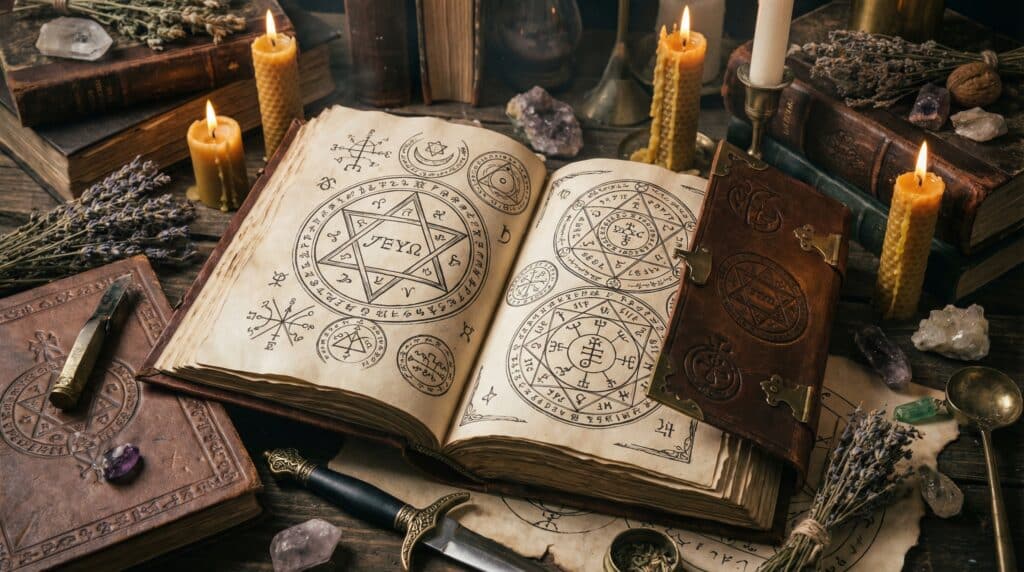
The shadow of King Solomon Ring stretches long into the medieval and Renaissance periods. The Clavicula Salomonis (The Key of Solomon) and the Lemegeton (The Lesser Key of Solomon) are foundational texts of Western ceremonial magic. These grimoires claim to preserve the methods used by Solomon, including the construction of magical circles, the consecration of pentacles, and the invocation of spirits. While they may not all claim to reproduce the physical King Solomon Ring, they operate on the same premise: that authority over spirits is granted through divine seals and names.
Practitioners of Solomonic magic today still utilize the symbolism of King Solomon Ring. The ring is viewed not just as a physical object, but as a spiritual state of authority. To “wear” King Solomon Ring metaphorically is to align one’s will with the Divine to bring order to the lower spheres. The legend of King Solomon’s Seal essentially birthed the genre of Goetia (magic regarding the binding of demons), making it arguably the most influential magical artifact in human history, surpassing even the Holy Grail in terms of practical application in occult literature.
Conclusion
King Solomon’s Ring is more than a mythical piece of jewelry; it is a complex symbol of wisdom, power, and the dangerous balance between the holy and the unholy. From its first mention in antiquity to its central role in the Testament of Solomon, the ring represents humanity’s desire to understand and control the unseen forces of the universe. It transforms Solomon from a mere mortal king into a cosmic architect, capable of bending demons to the will of Heaven.
Whether viewed through the lens of theology, archaeology, or occultism, the legend of King Solomon’s Seal endures because it answers a fundamental human question: How can we master our fears? The answer provided by the legend is clear through knowledge, faith, and the divine authority symbolized by King Solomon’s Seal. As we continue to explore ancient texts, the glint of brass and iron on the wise King’s finger continues to fascinate, warning us that while power is available, it must always be wielded with the wisdom of Solomon.



Pingback: The Prayer of Elijah – The 63-Word Prayer That Brought Fire From Heaven | Powerful Elijah Prayer - Soft Bible