For two thousand years, you have been told a comfortable lie about the fourth Gospel. The Book of John isn’t just a biography; it is a coded masterpiece that defies the other three texts in ways that should terrify traditionalists. It omits crucial events and introduces cosmic mysteries that were never meant for the masses.
Why does this specific book stand alone? And here is the most astonishing part: evidence suggests the true author wasn’t a fisherman, but someone whose identity unravels the entire accepted history of the early church. In this post, we will treat the Book of John not as a hymnal, but as a crime scene file waiting to be decoded.
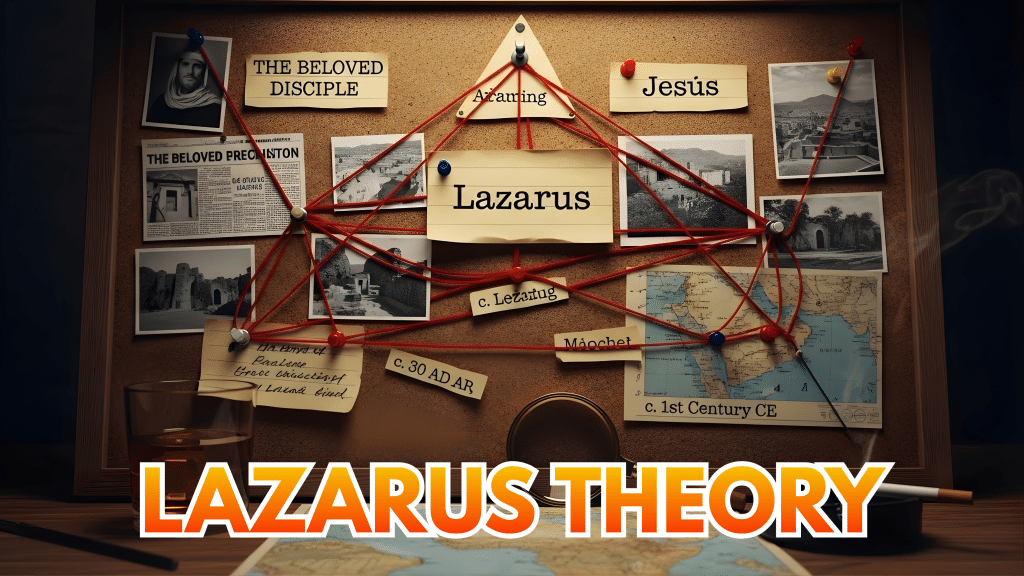
Table of Contents
- The Logos Mystery: The Word Before Time
- The Seven Signs: Decoding the First Miracle
- The Nicodemus Files: Secrets in the Night
- The Samaritan Woman: A Forbidden Encounter
- The Bread of Life: A Hard Saying in the Book of John
- The Mystery of the Beloved Disciple
- The Feast of Tabernacles: Dangerous Whispers
- The Light of the World: A Blind Man’s Trial
- The Good Shepherd: Coded Language of Leadership
- The Lazarus Project: The Ultimate Sign
- The Upper Room: Secret Instructions
- The High Priestly Prayer: Celestial Communication
- The Passion Mystery: Victory in Defeat
- The Empty Tomb: The First Witness
- The Sea of Tiberias: The Final Code
- Frequently Asked Questions
The Logos Mystery: The Word Before Time
Open the synoptic gospels—Matthew, Mark, and Luke—and you find earth, dirt, blood, and lineage. You find a human story rooted firmly in history. You see a birth in Bethlehem, a genealogy tracing back to Abraham or Adam, and a narrative that moves forward in linear time. Now, open the fourth file. Open the Book of John. Where is the manger? Where are the shepherds? Where is the mother?
They are gone. In their place, we find a void. We are not standing in first-century Judea; we are suspended in a cosmic vacuum before the ignition of the universe. The author of this text has deliberately suppressed the nativity story to present us with something far more unnerving. He begins with a deliberate echo of the very first sentence of the Hebrew Bible. “In the beginning.” But instead of God creating the heavens and the earth, we are introduced to an entity simply called “the Word.”
This brings us to the most significant linguistic clue in the entire text. In the original Greek manuscripts, this term is Logos. To translate Logos merely as “Word” is to miss the entire motive of the author.
Think about what this implies about the writer’s intent. He isn’t writing for uneducated fishermen. He is targeting the intelligentsia of the ancient world. He is bridging the gap between Jerusalem and Athens. This is our first major piece of evidence that the Book of John was constructed as a theological thesis rather than a simple biography. The protagonist here is not presented as a man who becomes important; he is presented as the pre-existent architect of reality itself.
This concept of pre-existence is a radical departure from the other three narratives found alongside the Book of John. In the other gospels, the story begins at conception or baptism. Here, the protagonist is older than time. How does a first-century mind even conceptualize a human being who existed before the stars were formed? The text claims that “all things were made through him.” This effectively removes the central figure from the category of “creation” and places him in the category of “creator.”
The Seven Signs: Decoding the First Miracle
The prologue has ended. The cosmic poetry of the Logos has faded, and the investigation now moves from the abstract to the concrete. We are tracking this pre-existent entity as he steps into the physical world. If our profile is correct—if this figure is indeed the architect of reality—then his interactions with the physical laws of nature within the Book of John should leave a distinctive footprint.
We track him to a wedding in Cana of Galilee. To the casual observer, what happens next is a celebration saved by a miraculous provision of wine. But look closer at the text. The author, who we have established is writing a coded theological thesis, refuses to use the standard Greek word for “miracle.”
In the other accounts, the writers use the word dynamis, meaning “act of power.” It implies a feat of strength or magic. But the author of the fourth gospel never uses this word. Instead, he selects a specific, loaded term: semeion.
- Semeion: In ancient Greek, this was a sign, a marker, or a signal flag used by military commanders.
A sign is not the destination; it is a pointer indicating something else. This tells us that the event at Cana is not about the wine. It is a navigational marker pointing to a hidden reality. Let’s reconstruct the scene at the wedding. The narrative zooms in on a very specific set of props: six stone water jars. The text is obsessive about the details, noting that they are made of stone and hold twenty to thirty gallons each. Why does the material matter?
When the protagonist commands these jars to be filled, he is not just providing a beverage. He is commandeering the machinery of the old religious system. He takes the water of ritual purification—tasteless, colorless, and focused on external cleaning—and transmutes it into wine. Do you see the subversion? The sign suggests that the old system of ritual cleansing is obsolete. This theme recurs throughout the Book of John.
The Nicodemus Files: Secrets in the Night
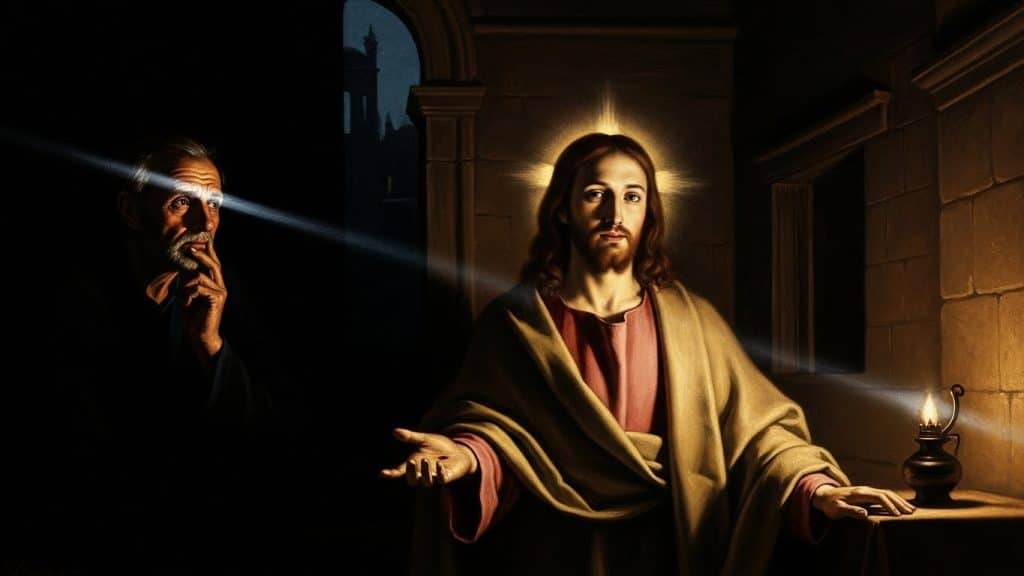
We move now from the cosmic prologue to the dark, narrow streets of the holy city. We are opening the file on a man named Nicodemus. Look closely at his profile. This is not a peasant. This is not a fisherman. He is described as a “ruler of the Jews,” a member of the Sanhedrin.
Why does this meeting happen under the cover of darkness? The text is deliberate about the timing. In the Johannine narrative, “night” is never just a time of day; it is a symbol of spiritual ignorance and danger. But practically speaking, Nicodemus is terrified.
He opens the dialogue with flattery, but Jesus immediately cuts the wire. He bypasses the pleasantries and issues a directive that sounds like a riddle: “Unless one is born again, he cannot see the kingdom of God.” Here, the investigation hits a linguistic wall that has confused readers of the Book of John for centuries. We must look at the original Greek. The word Jesus uses is anothen.
This is a verbal trap. Nicodemus, thinking with an earthly mindset, hears “again.” He falls into the trap, asking the absurd question: “Can a man enter a second time into his mother’s womb?” He is thinking biologically. But Jesus is speaking of the second meaning—”from above.” He is describing a spiritual download that rewrites the human operating system.
The Samaritan Woman: A Forbidden Encounter
We follow the trail of the protagonist south, leaving the familiar, orthodox jurisdiction of Judea and crossing into the hostile badlands of Samaria. The rift between Jews and Samaritans was centuries deep, a cold war fueled by blood feuds and violent disputes over the true location of God’s temple. Any respectable traveler would walk miles out of their way to bypass this contamination zone. Yet, the subject of our investigation in the Book of John walks straight into the center of the conflict.
He arrives at Jacob’s Well. The time stamp is critical evidence: the sixth hour. High noon. To be at the well at noon is to admit social death. It implies shame. Enter the Samaritan woman. She is alone, exposed, and vulnerable.
Why does the text highlight the immediate breach of these boundaries? By asking her for a drink, the protagonist isn’t just being friendly; he is dismantling the segregation laws of his culture. The dialogue that follows is not a simple conversation; it is a verbal sparring match. The protagonist counters with a cryptic offer: “Living Water.”
He introduces a new frequency of connection: worship in “Spirit and Truth.” He is effectively decommissioning the Temple in Jerusalem before the Romans even arrive to destroy it. He is claiming that the hardware of stone and mortar is obsolete; the software of connection is now internal. The location of God is no longer a GPS coordinate; it is a state of being.
The Bread of Life: A Hard Saying in the Book of John
The investigation now shifts to the wilderness, a remote sector near the Sea of Galilee. We find a scene that looks less like a sermon and more like a logistical crisis. The files indicate a crowd of five thousand men. This is a massive security risk. The suspect, Jesus, performs a sign that defies the laws of thermodynamics: the multiplication of loaves and fish.
But the crowd is relentless. The next day, they track him down to the synagogue in Capernaum. Here, the suspect initiates a psychological confrontation that effectively destroys his own polling numbers. He claims to be the “True Bread” from heaven.
Then, he drops the statement that acts as a jagged filter for his followers: “The bread that I will give for the life of the world is my flesh.” The listeners are baffled. Instead of softening the rhetoric, he doubles down. “Unless you eat the flesh of the Son of Man and drink his blood, you have no life in you.”
Why would a leader sabotage his own movement with such grotesque imagery? This was a public relations suicide. But in the context of the Book of John, he is deliberately making the message offensive to weed out the casual observers. He is drawing a line in the sand between those who want free lunch and those who can stomach the reality of the Incarnation.
Investigating the Mystery of the Beloved Disciple
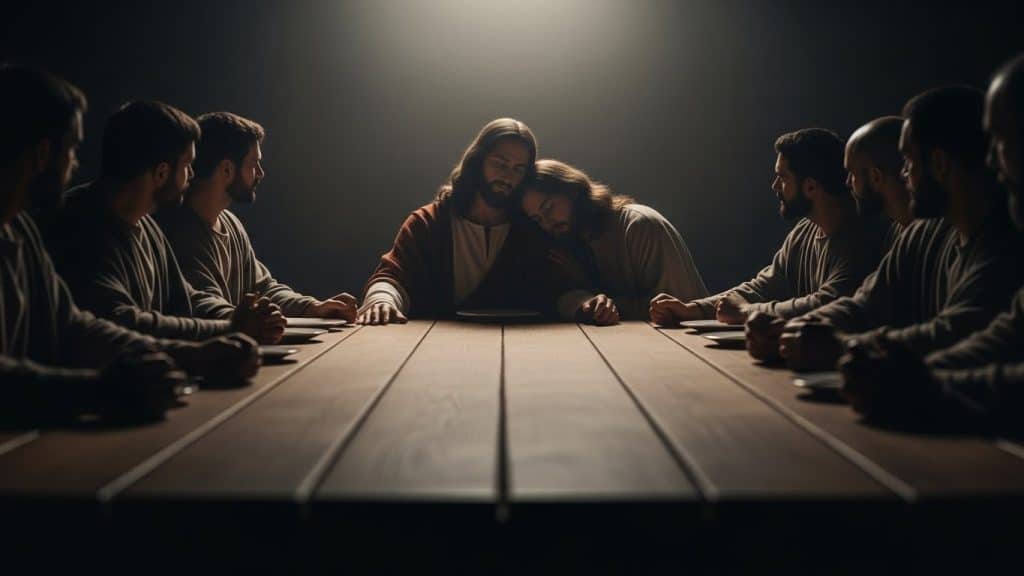
We have arrived at the final, and perhaps most elusive, layer of our investigation. Who is the informant? In a standard police report, the witness identifies themselves immediately. But here, the author is a ghost. He refers to himself only by a code: “The disciple whom Jesus loved.”
Is this a title of supreme arrogance, or is it a protective alias? This nameless figure appears at the most critical junctures of the case file. Critics have argued that the Book of John was a forgery, but the forensic details embedded in the text suggest otherwise. The author remembers the specific aroma of the perfume. He records the exact weight of the spices brought for the burial—seventy-five pounds. These are the granular recollections of a man who was in the room.
But the most damning piece of evidence regarding his identity is found in the courtyard of the High Priest. While Peter is shivering by a fire, this “Beloved Disciple” walks right past the guards. The text explicitly states that this disciple was “known to the High Priest.” This detail destroys the profile of a simple uneducated laborer. It suggests our author is a man of status, an insider operating behind enemy lines.
The Feast of Tabernacles: Dangerous Whispers
Imagine the city of Jerusalem, not as a holy site, but as a pressure cooker waiting to explode. We are fast-forwarding to Chapter 7 of the Book of John. It is the Feast of Tabernacles. The narrative begins with a domestic confrontation that feels more like a tactical disagreement within an insurrection cell.
Why does a man who claims to be the Light of the World suddenly cloak himself in darkness? He enters the hostile zone of Jerusalem “not openly, but in secret.” This is behavior consistent with a target under surveillance. He knows there is a warrant out for him. The authorities are actively hunting him.
Then comes the flashpoint. It is the last great day of the feast. For seven days, the High Priest has poured water out on the altar. At the exact moment of this ritual climax, the protagonist breaks protocol. He stands up and shouts: “If anyone thirsts, let him come to me and drink.” He is effectively hijacking the most sacred ritual of the festival to declare himself the source of the nation’s life.
The Light of the World: A Blind Man’s Trial
We are now opening one of the most detailed case files in the entire Johannine dossier. The protagonist stands before a man born blind and makes his most audacious claim yet: “As long as I am in the world, I am the light of the world.” Then, he proceeds to prove it with a method so visceral it demands forensic analysis.
He spits on the ground, mixes his saliva with the dust to create mud, and smears this clay over the blind man’s eyes. By replicating the act of creation from Genesis, the protagonist acts as the Creator. But there is a legal problem here: He performs this act on the Sabbath.
The neighbors are confused. The man is brought to the Pharisees. What follows is a rigorous, hostile interrogation. The authorities are not looking for the truth; they are looking for a loophole. But the beggar delivers one of the most devastating lines of testimony in the entire Book of John: “One thing I do know. I was blind but now I see!” The Light of the World has revealed that the established religious structure is operating in total darkness.
The Good Shepherd: Coded Language of Leadership
We arrive at Chapter 10, often sentimentalized in stained glass windows. But you must strip away the sentimentality to understand what is actually being said here. The author is using a coded language known as the mashal. The setting is a sheepfold—a stone fortress against the wilderness.
When the protagonist declares, “I am the door,” he is establishing a security checkpoint. If he is the only legitimate point of entry, then who are the men currently running the Temple? The text labels them “thieves and robbers.” This is a devastating accusation against the religious aristocracy.
In the first-century context, the “wolf” was often a code for Rome or the corrupting influence of the Herodian dynasty. The hired hand flees because he has no skin in the game. But the Shepherd stays. He asserts: “I and the Father are one.” He has just looked the guardians of monotheism in the face and claimed to be the operating system of God himself.
The Lazarus Project: The Ultimate Sign
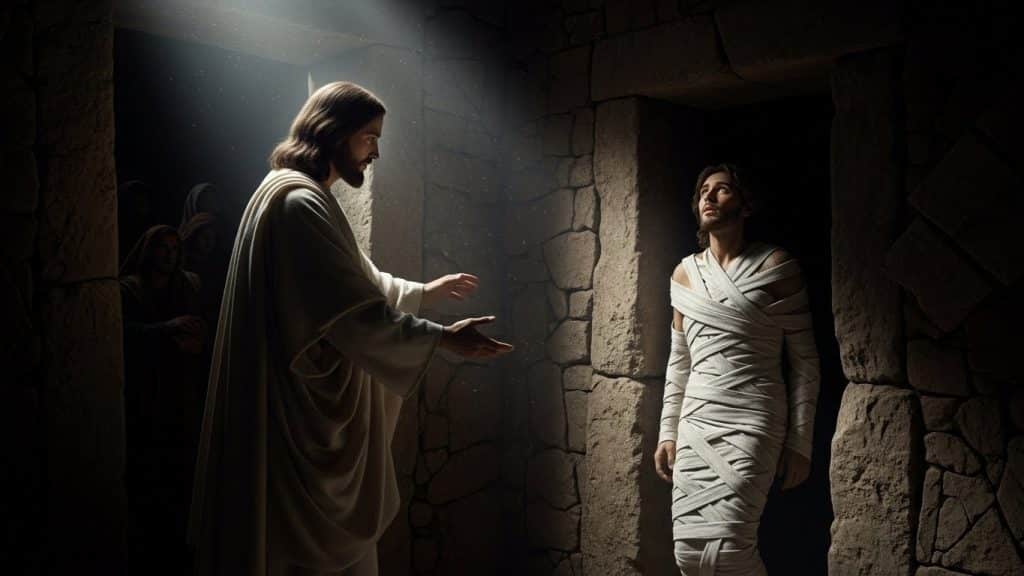
The investigation into the “Lazarus Project” reveals a deliberate, chilling pause in the timeline. Upon receiving intelligence that Lazarus is sick, the protagonist does not move. He waits. He stays where he is for two more days. Jesus is not waiting for Lazarus to recover; he is waiting for him to die.
Jesus has waited for this precise window. He moves to the tomb and commands: “Lazarus, come out!” Entropy is reversed. The dead man shuffles out. But here is where the investigation in the Book of John takes its darkest turn. This miracle does not bring peace; it signs the death warrant. The raising of Lazarus is the tipping point that forces the hand of the establishment. The religious authorities issue a second hit order: they make plans to kill Lazarus as well, to destroy the evidence.
The Upper Room: Secret Instructions
We now move from the open streets of Jerusalem to a secure, undisclosed location within the city walls: The Upper Room. This is the final operational briefing. The doors are locked. The world outside is hostile.
The evening begins with a shock. The suspect, the man they call Lord, wraps a towel around his waist and washes the feet of his operatives. He is dismantling the pyramid of power. But as the water turns murky, the atmosphere darkens. The investigation reveals that the enemy has already infiltrated the inner circle. Jesus identifies the mole with a dipped morsel of bread. Satan enters Judas, and he leaves into the night.
With the traitor gone, Jesus issues the “New Commandment”: Love one another as I have loved you. This is the counter-intelligence signal by which the members of this movement will recognize each other in a hostile world.
The High Priestly Prayer: Celestial Communication
We have arrived at Chapter 17. The Book of John provides a verbatim record of a conversation between the Son and the Father. It reads like a wiretap on a private line between heaven and earth. “Father, the hour has come.”
He asks for “glory.” “Glorify me in your own presence with the glory that I had with you before the world existed.” He is confirming his profile as the pre-existent Logos. He effectively checks out of the hotel of earthly existence and asks for his keys back to the celestial throne room. He prays for his operatives—the disciples—not to be taken out of the world, but to be kept from the Evil One. They are to remain deep cover agents behind enemy lines.
The Passion Mystery: Victory in Defeat
We enter the garden of Gethsemane. If you cross-reference this with the other case files, you will notice a startling omission in the Book of John. There is no agony here. There is no sweating of blood. Why? Because consistent with his thesis, the Logos is not a victim; he is a commander on a mission.
When the troops arrive, he says, “I am.” The detachment of soldiers falls to the ground. This is not an arrest; it is a surrender negotiated by the target. At the trial, Pilate asks, “What is truth?” while staring directly into the face of the Absolute.
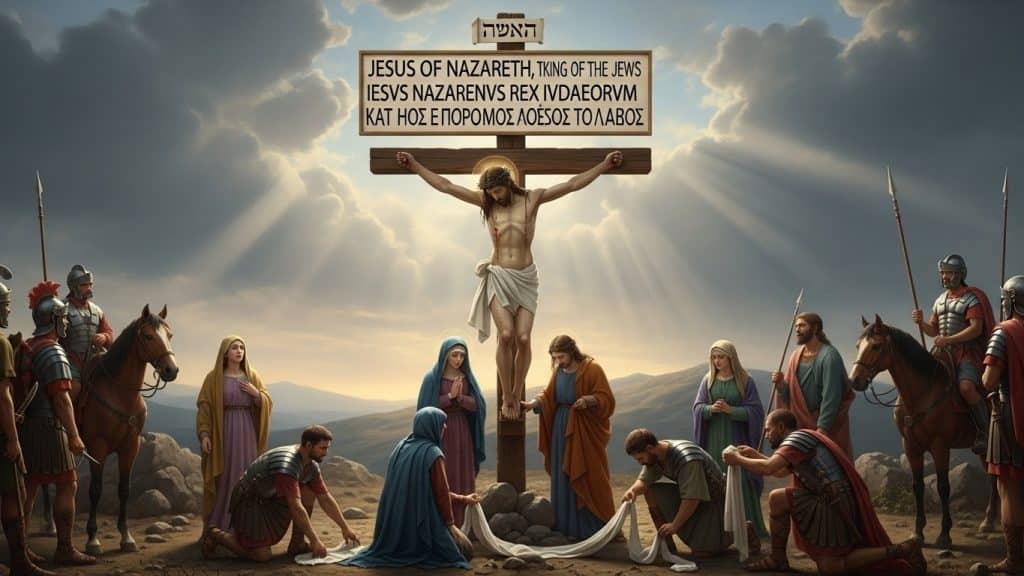
Finally, on the cross, the protagonist cries out one single word in Greek: Tetelestai. “It is finished.” This is an accounting term. It means the debt is paid in full. He releases his life; it is not taken from him. Even in death, his body acts as the new Temple.
The Empty Tomb: The First Witness
The investigation has reached its flashpoint. We begin with the first person to arrive at the scene of the disappearance: Mary Magdalene. If the disciples were fabricating a myth, choosing Mary as the primary witness would be a catastrophic error, as a woman’s testimony held no legal weight in that era. The fact that the file records her presence is a strong indicator of historical authenticity.
She finds the stone removed. Peter and the Beloved Disciple run to the scene. Inside, they find a crime scene that defies the logic of grave robbery. The face cloth is folded neatly. A grave robber does not take the time to fold a napkin. This signals a calm, deliberate departure.
The Sea of Tiberias: The Final Code
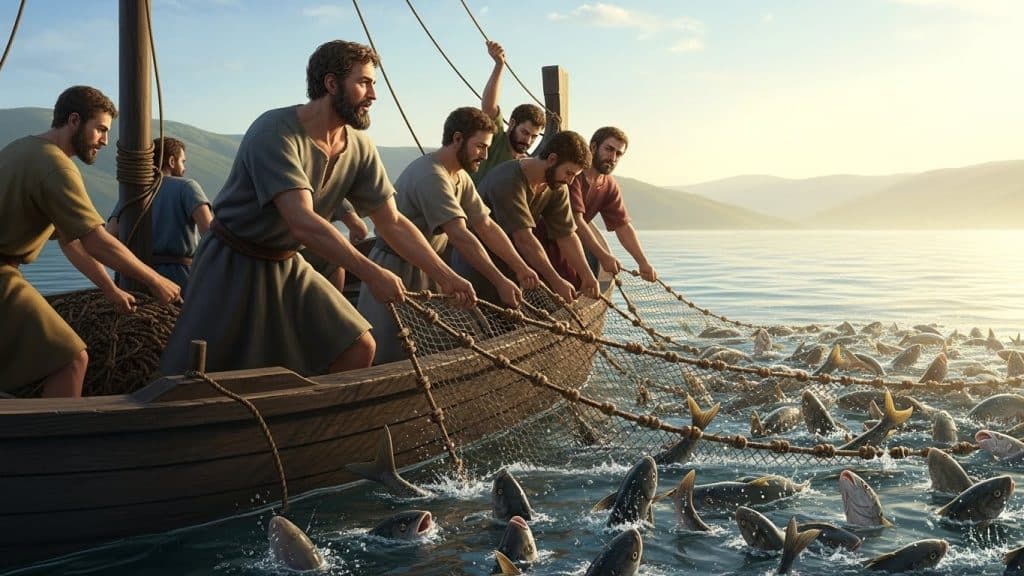
We have arrived at the epilogue. The tomb is empty, and the investigation returns to the remote waters where it all began. The disciples are fishing but catching nothing. A stranger on the shore commands them to cast the net on the right side. The result is a specific number: 153 large fish.
On the shore, Jesus recreates the charcoal fire—the scent of Peter’s betrayal—to restore him. And so, the investigation closes. The dossier is full. The author ends with a statement of infinite scale: “The world itself could not contain the books that would be written.” The file on the Son of God can never be closed. The investigation is over, but the verdict is yours: do you believe?
Frequently Asked Questions
Who wrote the Book of John?
The text identifies the author as “the disciple whom Jesus loved.” Tradition identifies him as John the Apostle, son of Zebedee, but forensic analysis of the text suggests he was a high-status individual with access to the High Priest’s court in Jerusalem.
What is the main focus of the Book of John?
Unlike the synoptic gospels that focus on the human lineage and history of Jesus, the Book of John focuses on his divinity, presenting him as the pre-existent “Logos” or Word of God who became flesh.
Why is the Book of John so different from the other Gospels?
The Book of John contains unique stories like the raising of Lazarus, the wedding at Cana, and the encounter with the Samaritan woman. It omits the nativity and parables to present a theological thesis on the identity of Jesus as God.
What does Logos mean in the Book of John?
In the first century, Logos meant “Reason” or the organizing principle of the universe. By calling Jesus the Logos, the author bridges Jewish theology and Greek philosophy, claiming Jesus is the architect of reality.
Who is the Beloved Disciple?
The Beloved Disciple is the anonymous author of the Fourth Gospel. Theories range from John the Apostle to Lazarus, or a Jerusalem-based disciple whose identity was hidden for protection.