Table of Contents
- The Persian Paradox: Cyrus and the Biblical Blueprint
- The Mystery of Elam: Prophecies for the Latter Days
- Spiritual Warfare: The Prince of the Kingdom of Persia
- Esther and the Shadow of Haman: The Spirit of Genocide
- The Ezekiel 38 Alliance: Persia’s Place in the End Times
- The American Enigma: Is the USA in Prophecy?
- Nuclear Ambition: Fire From the Sky?
- The Underground Revival: Iran’s Spiritual Revolution
- The Medes and the Kurds: The Forgotten Allies
- The Euphrates Drying Up: Preparing the Way
- The Valley of Decision: Final Judgment
- Frequently Asked Questions
You’ve been led to believe the West is the protagonist of the end times. But open the ancient prophecies, and you won’t find America mentioned explicitly. Instead, you find Persia—modern-day Iran—mentioned by name as a central player in the final days. While the world watches Washington, Scripture focuses on Tehran. This is the core of understanding Iran in Bible prophecy.
Here is the most astonishing part: the biblical silence regarding the United States isn’t an oversight. It suggests a terrifying possibility that the world’s greatest superpower might not even survive to see the end as we know it. To truly grasp the future, we must look at what the texts say about Iran in Bible prophecy versus the ominous absence of the West.
The Persian Paradox: Cyrus and the Biblical Blueprint
Rewind the tape of history. Erase the headlines of nuclear centrifuges, drone strikes, and embassy sieges. What you find underneath the rubble of modern geopolitics is a contradiction so stark it demands an explanation. We call it the Persian Paradox. To understand Iran in Bible prophecy, we have to uncover the beginning.
It starts with a name. A name whispered by the prophet Isaiah one hundred and fifty years before the man was even born. Cyrus. But it is not just the name that stops you cold; it is the title. In the entire Old Testament, the title of ‘Messiah’—the Anointed One—is typically reserved for Jewish kings, high priests, and eventually, the coming Savior. It is a holy designation, separated for God’s exclusive use. Yet, in Isaiah chapter 45, the God of Israel bestows this supreme honor upon a Persian Emperor.
How could the head of a foreign empire be the only Gentile in the Bible to carry the title of Christos? This is the first clue in our investigation of Iran in Bible prophecy. The Bible does not describe ancient Iran as a realm of terror, but as an instrument of divine redemption. While the Babylonians were the destroyers who torched Jerusalem, the Persians arrived as the liberators.
Follow the money trail. In the books of Ezra and Nehemiah, we do not just see permission; we see patronage. The reconstruction of the Jewish Temple was a state-sponsored project funded by the Persian treasury. For centuries, the relationship between the Jewish people and the Persian Empire was not one of hostility; it was a symbiotic alliance. A history of friendship that outlasted dynasties.
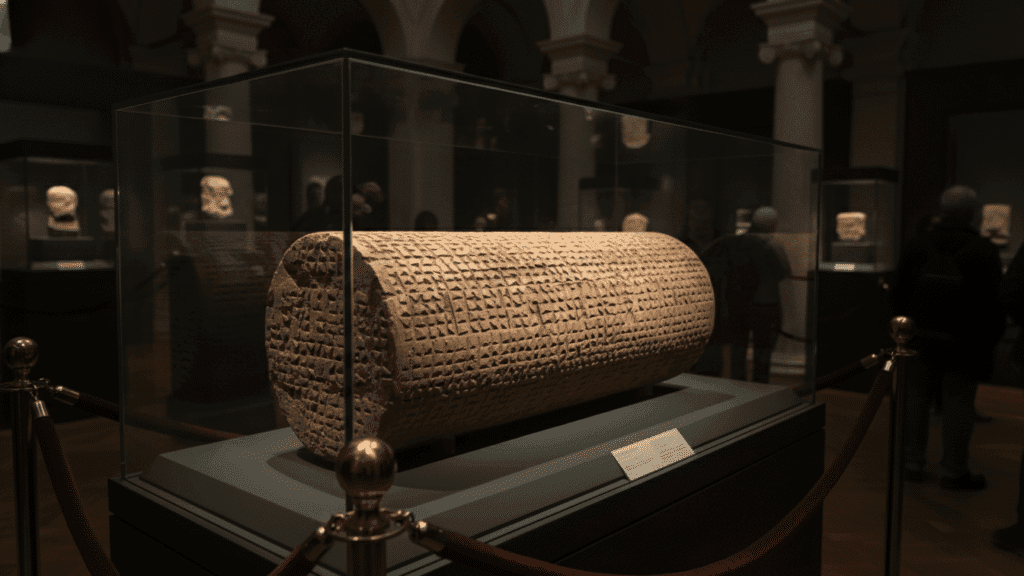
But can we trust the text? The skeptic demands physical evidence. For that, we turn to the British Museum, where the Cyrus Cylinder rests as a silent witness. It speaks of a king who conquers without burning, who frees the captives, and restores their sanctuaries. The Bible and the spade tell the same story: Persia was the ancient world’s unlikely guardian of liberty. This historical context is vital when studying Iran in Bible prophecy because it highlights the drastic shift to modern enmity.
The Mystery of Elam: Prophecies for the Latter Days
Deep within the prophetic archive lies a dossier that has baffled scholars for centuries. It does not speak of a general war, but of a specific, localized event with global fallout. This is the mystery of Elam. While most eyes are locked on the prophecies concerning Persia in Ezekiel, Jeremiah 49 presents a distinct timeline regarding Iran in Bible prophecy.
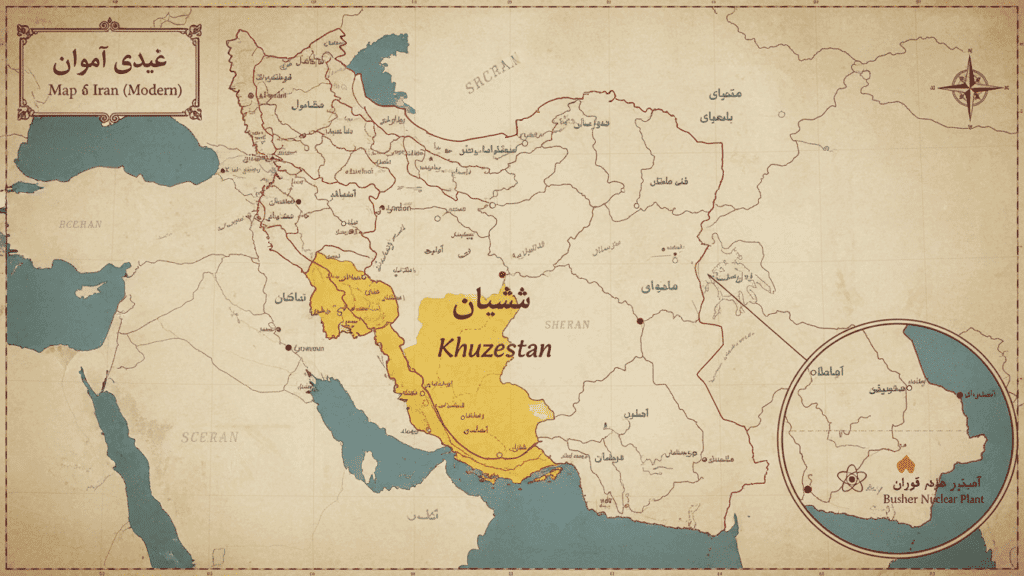
Ancient Elam is not the entirety of modern Iran. It is a specific region in the southwest, hugging the Persian Gulf—known today as the Khuzestan province. Crucially, this is the exact location of the Bushehr nuclear power plant. When Jeremiah prophesies against Elam, he is targeting the coastline that hosts the nation’s most sensitive strategic assets.
The investigation deepens when we decipher verse 35: ‘Behold, I will break the bow of Elam, the chief of their might.’ In modern military terms, the “bow” translates to missile capability. If we view this through the lens of modern defense and Iran in Bible prophecy, the text suggests a catastrophic failure or a preemptive destruction of the region’s ability to launch attacks.
But the prophecy describes more than just military neutralization; it outlines a humanitarian disaster. Jeremiah speaks of ‘four winds’ scattering the inhabitants. This implies a central point of calamity radiating outward—identifiable perhaps as a nuclear fallout or a massive environmental catastrophe. Yet, amidst the chaos, the Creator makes a startling claim: ‘I will set My throne in Elam.’ This indicates that while the regime faces judgment, a spiritual awakening awaits the people.
Spiritual Warfare: The Prince of the Kingdom of Persia
To understand the headlines, we must look behind the curtain of history. The Bible suggests that the political map of the Middle East is merely a physical overlay of a much darker geography. This is a central theme of Iran in Bible prophecy: the battle is not just physical, but spiritual.
Picture the prophet Daniel on the banks of the Tigris. For three weeks, he fasts, but the heavens are silent. Finally, an angelic messenger reveals the cause of the delay: “The prince of the kingdom of Persia withstood me twenty-one days.”
This “Prince” was not a human king like Cyrus. It was a spiritual entity, a high-ranking authority in the hierarchy of darkness holding jurisdiction over the territory of Persia. This passage introduces the concept of territorial spirits. The blockade over the Persian skies was so formidable that Michael the Archangel had to engage in direct combat to break the deadlock.
This leads us to the most uncomfortable question of our investigation into Iran in Bible prophecy. Spiritual beings do not die. If this “Prince of Persia” was active in the days of Daniel, has he ever left? We look at modern Iran and see a nation that has shifted from a protector of the Jewish people to their existential threat. Are we witnessing the manifestations of that same ancient, dark authority?
Esther and the Shadow of Haman: The Spirit of Genocide
Deep within the archives of history lie the ruins of Shushan, the setting of the Book of Esther. Here, our investigation of Iran in Bible prophecy shifts to high-stakes political intrigue. The Jews of Susa were not merely slaves; they were embedded in the empire. But integration did not guarantee safety.
We must examine the antagonist: Haman the Agagite. This is not a trivial detail. Agag was the king of the Amalekites, the arch-enemies of Israel. We are not looking at a new grievance, but an ancient spiritual blood feud. Haman sought total erasure, a calculated administrative approach to mass murder.
As we fast-forward to the present, the echoes of Susa become deafening. When modern leaders in the region speak of wiping a nation off the map, they are channeling this ancient spirit. The gallows Haman built were designed for a public spectacle of death. Today, the gallows are metaphorical—built of enriched uranium—but the intent remains identical. This cyclical history is a key component of understanding Iran in Bible prophecy.
The Ezekiel 38 Alliance: Persia’s Place in the End Times
To understand the future, we must open the dossier of Ezekiel 38. This is not merely a poetic warning; it is a specific military blueprint. The prophet describes a massive confederacy rising from the “uttermost parts of the north,” led by “Gog.” But the true shock lies in who stands at his right hand: Persia.
This is the explicit mention of Iran in Bible prophecy. For most of the twentieth century, a military alliance between Moscow (Magog) and Tehran (Persia) was unthinkable. Yet, today we watch as Russian jets and Iranian drones operate in unison. We are watching the formation of the Ezekiel 38 alliance in real-time.
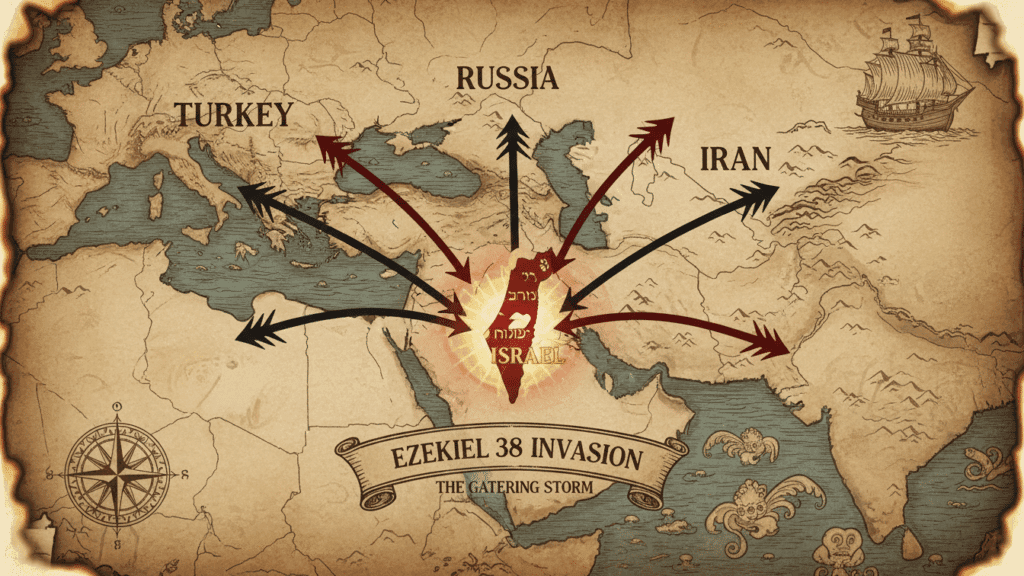
The text describes a strange motivation: a “hook in their jaws.” It is not purely ambition that moves them, but a divine compulsion. Their target is the “Mountains of Israel.” The script describes a catastrophe that is not man-made—an earthquake, pestilence, and fire that destroys the invaders. But as we analyze this, we notice a glaring omission. Where is the world’s greatest superpower?
The American Enigma: Is the USA in Prophecy?
We have traced the borders of Persia, but there is a gaping hole in the narrative. Iran in Bible prophecy is clear, but the United States is missing. How could the prophets miss the world’s sole superpower?
This is the “American Enigma.” One theory lies in Ezekiel’s description of the spectators: “Sheba, Dedan, and the Merchants of Tarshish and all their young lions.” If Tarshish represents the ancient maritime powers of Europe, then the “young lions” are their colonial descendants—nations like the United States. But notice their posture. They do not intervene. They merely issue a diplomatic protest.
This suggests a chilling scenario where the United States is unwilling or unable to defend Israel directly. Perhaps political division has paralyzed the giant, or economic collapse has rendered it irrelevant. The American Enigma suggests that at the climax of history, as Iran in Bible prophecy reaches its fulfillment, the Middle East will face its destiny without Western intervention.
Nuclear Ambition: Fire From the Sky?
Deep beneath the Zagros Mountains, thousands of centrifuges spin. This is the atomic threshold. But for the detective of history, this hum echoes the whispers of prophets. The prophet Joel describes “blood and fire and pillars of smoke” before the day of the Lord. Could these pillars, expanding into a terrifying canopy, be a description of a nuclear detonation?
The Apostle Peter writes that the elements will “melt with fervent heat.” To a physicist, this reads like nuclear fission. The constant state of tension between the West and Tehran mirrors the biblical warning of “wars and rumors of wars.” The pursuit of the bomb by the Iranian regime might not just be for deterrence; in the context of Iran in Bible prophecy, it could be the trigger for a pre-written destiny.
The Underground Revival: Iran’s Spiritual Revolution
While the news focuses on missiles, a volatile chain reaction is taking place in the shadows. Deep beneath the concrete of the Islamic Republic, the spiritual tectonic plates are shifting. This is the untold story of Iran in Bible prophecy.
Operation World identifies Iran as having the fastest-growing evangelical church in the world. When a government mandates religion by force, it creates a vacuum of genuine spirituality. Disillusioned by the state, the youth are turning to a movement without cathedrals—the underground house church.

Reports flood in of supernatural encounters—dreams of a “Man in White.” The prophecy of Jeremiah regarding setting a “throne in Elam” may well be a spiritual one. The path to peace might not be found in a treaty, but in a revival that rewrites the spiritual DNA of the nation.
The Medes and the Kurds: The Forgotten Allies
The Bible speaks of the “Medes and the Persians.” If the Persians are the Iranians, who are the Medes? Historical and linguistic evidence points to the modern-day Kurds. This identification is crucial for understanding the internal dynamics of Iran in Bible prophecy.
Isaiah 13:17 declares, “Behold, I will stir up the Medes against them.” The Kurds, inhabiting the mountainous regions of Iran, Iraq, and Turkey, have never truly submitted to Tehran. They represent a fracture in the Iranian armor. The “stirring” Isaiah spoke of may manifest as a push for independence or a revolt, positioning the Kurds as a biblical counter-force from within.
The Euphrates Drying Up: Preparing the Way
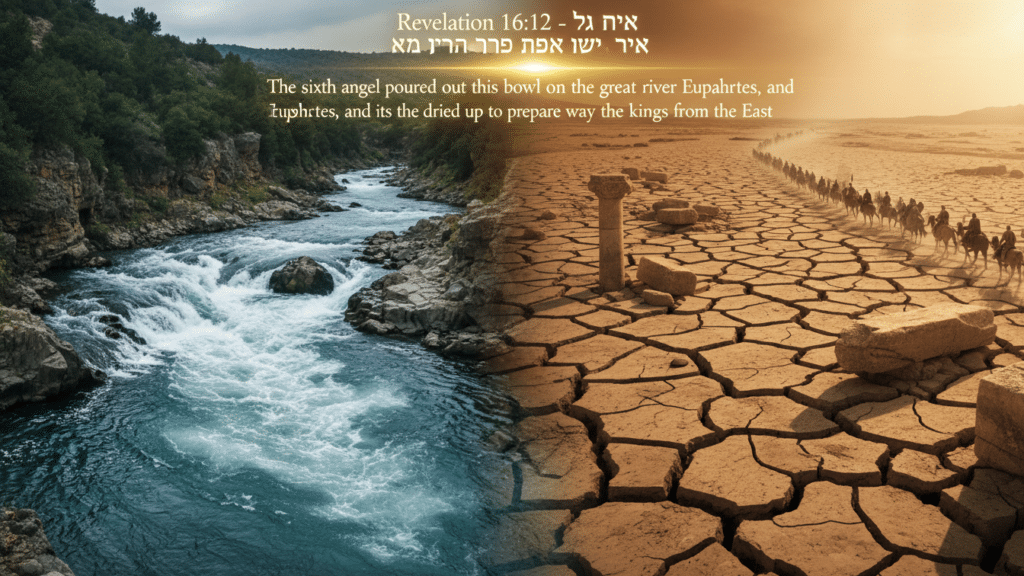
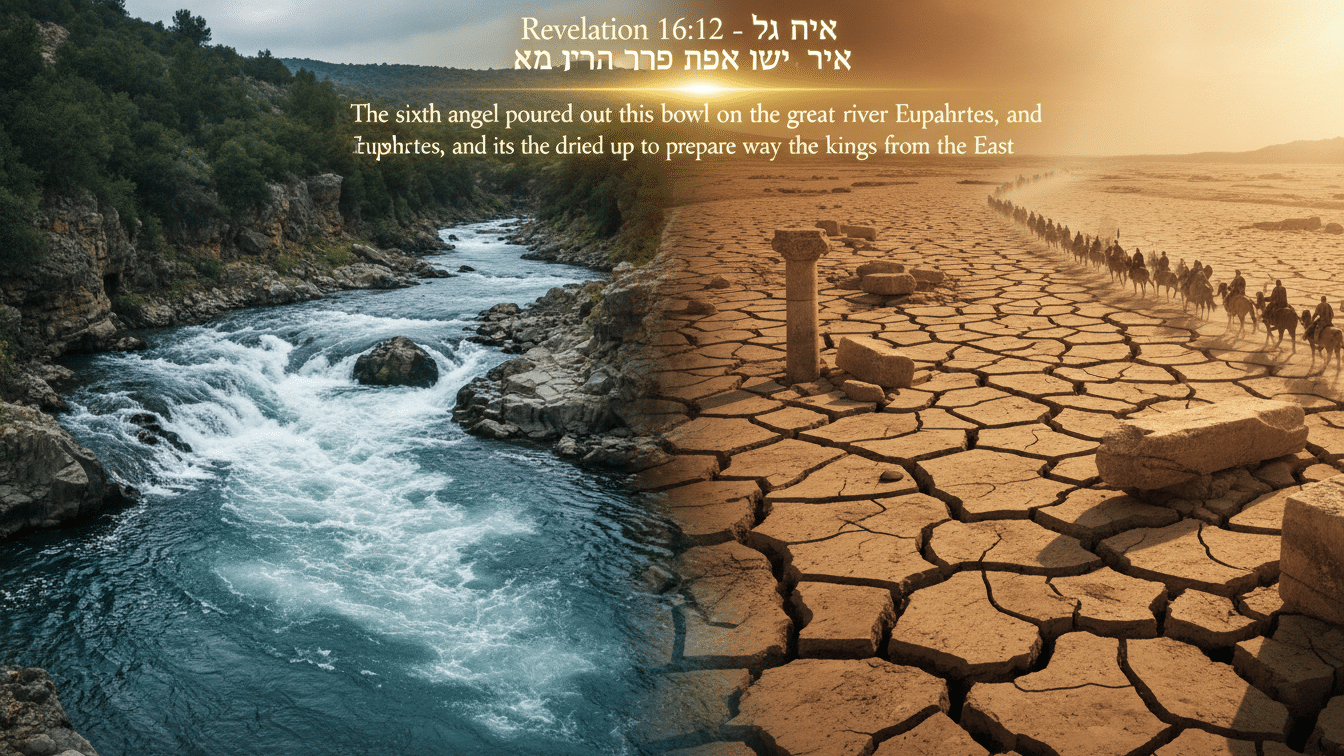
Revelation 16 states that the sixth angel pours out his vial on the Euphrates, drying it up to prepare the way for the “Kings of the East.” Today, through dams and drought, the Euphrates is gasping for breath. This is more than ecology; it is eschatology.
Iran sits as the land bridge connecting the Middle East to the rising superpowers of the East. As the river dries, the physical barrier falls. Iran in Bible prophecy may serve as the doorman, holding the gate open for a massive Eastern coalition to march toward Armageddon.
The Valley of Decision: Final Judgment
Every trail ends in the Valley of Decision. Joel describes a place where history is put on trial. The alignment of nations—the East led by the spirit of Persia, and the West represented by the merchants of Tarshish—culminates here.
The indictment rests on the treatment of Israel. For the regime in Iran, which calls for Israel’s erasure, the Valley represents a terrifying accounting. Neither the Eagle nor the Ram holds final authority. The mystery of Iran in Bible prophecy concludes not with political victory, but with divine sovereignty.
As we stand at this crossroads, the American Enigma and the Persian Paradox converge. Whether through the fire of judgment or the fire of revival, the story concludes with the restoration of the people. The mystery is still unfolding, and the next clue could drop before the sun sets today.